# What do the people building xAI actually care about?
> Two weeks ago a tweet hit me: everyone wants into the frontier AI labs, as if you'll be left behind if you can't get in. Instead of just feeling the anxiety, I wanted to know — what do the people already inside actually care about? So I went through all 668 accounts on xAI's public list, one by one.
Author: Howard Peng (https://howard-peng.xyz)
Published: 2026-06-30
Canonical: https://howard-peng.xyz/2026/what-xai-people-care-about
Tags: xai, x, data
---
Two weeks ago, I saw a tweet.
The gist: right now everyone in the world wants to squeeze into one of the frontier AI labs — as if, if you can't get in, the era leaves you behind.
It hit me, because it isn't wrong. In 2026, being at one of these frontier AI labs is what being at Binance was in 2017 — **the top of the gale, everyone scrambling to know them, to get through that door.**
And I know what that feels like, because I was there for the last gale — I joined Binance in the summer of 2018. What's different this time is the scale: the ceiling I could reach playing it perfectly is roughly this generation's floor. ([I wrote that one up separately.](/2026/their-floor-was-our-ceiling))
So it left me with a complicated, bittersweet feeling. And that feeling is exactly what pushed me toward something concrete: these people standing at the top of the gale — what does their **social portrait** actually look like? **The people already inside — what do they actually care about?** What do they talk about every day, who are they, where does their influence even come from? I wanted to know. And I wanted to know more.
So I did something slightly obsessive: I started from xAI's public affiliates list ([x.com/xai/affiliates](https://x.com/xai/affiliates)) — **668 public accounts** — and looked at the publicly visible data for each: followers, following, bios, and the 30-day post-type mix. Everything anyone can see by clicking through — not what the bio says, but how they actually *behave*.
The result was the opposite of what I expected.
## Four types, and a brutally lopsided split
Plot two numbers — how many people you follow, and how many follow you — and four clear patterns fall out:
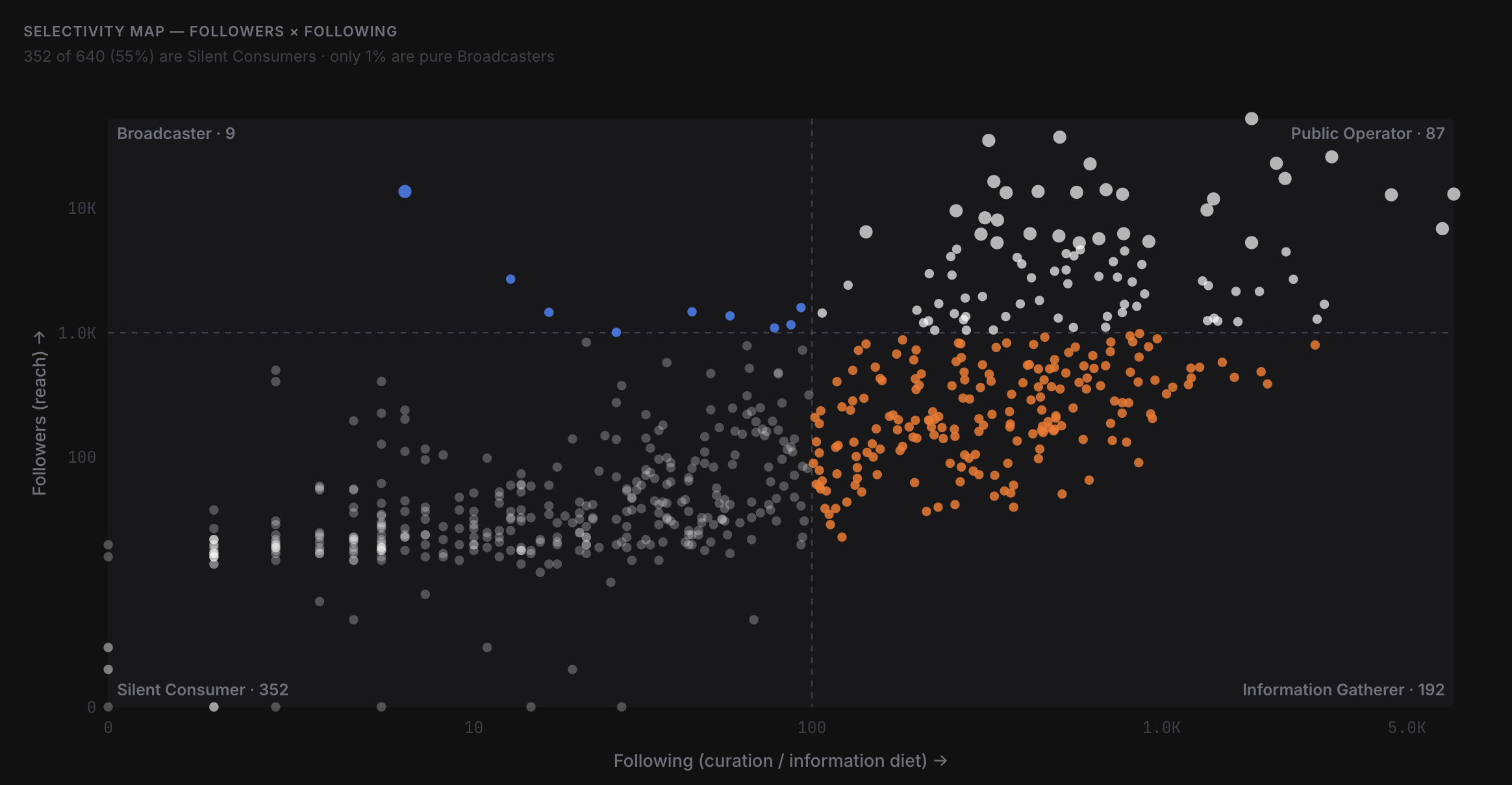
*Fig 1 — X axis = information diet (how many you follow); Y axis = reach (how many follow you).*
- **Silent Consumer — 55% (352)**: follow almost no one, almost no one follows them. Pure lurkers.
- **Information Gatherer — 30% (192)**: follow a lot, few followers of their own. Absorbing.
- **Public Operator — 14% (87)**: both follow and are followed. Actually "operating."
- **Broadcaster — only 1% (9)**: high reach, low input. The few true broadcasters.
More than half follow almost no one and are followed by almost no one — and genuinely high-reach, low-input broadcasters are just 1%. Inside one of the most cutting-edge AI companies, **close to six in ten are invisible on X.**
## First glance: most of them don't really run their own X
You see it with barely a scan, and the data backs it up. Across the 640 measurable accounts, **44% have a completely empty bio**, eight in ten are minimal profiles (under 50 characters); **53% have fewer than 100 followers**, and the number with over 100k followers is — **zero**. And their information diet is just as narrow: the median person follows only **67 accounts**, and **56% follow fewer than 100**.
Many aren't even X natives. About **a third of the accounts were created in just 2025–2026** — spun up around the time they arrived, not a decade of posting behind them. This isn't a group that grew up performing on the timeline.
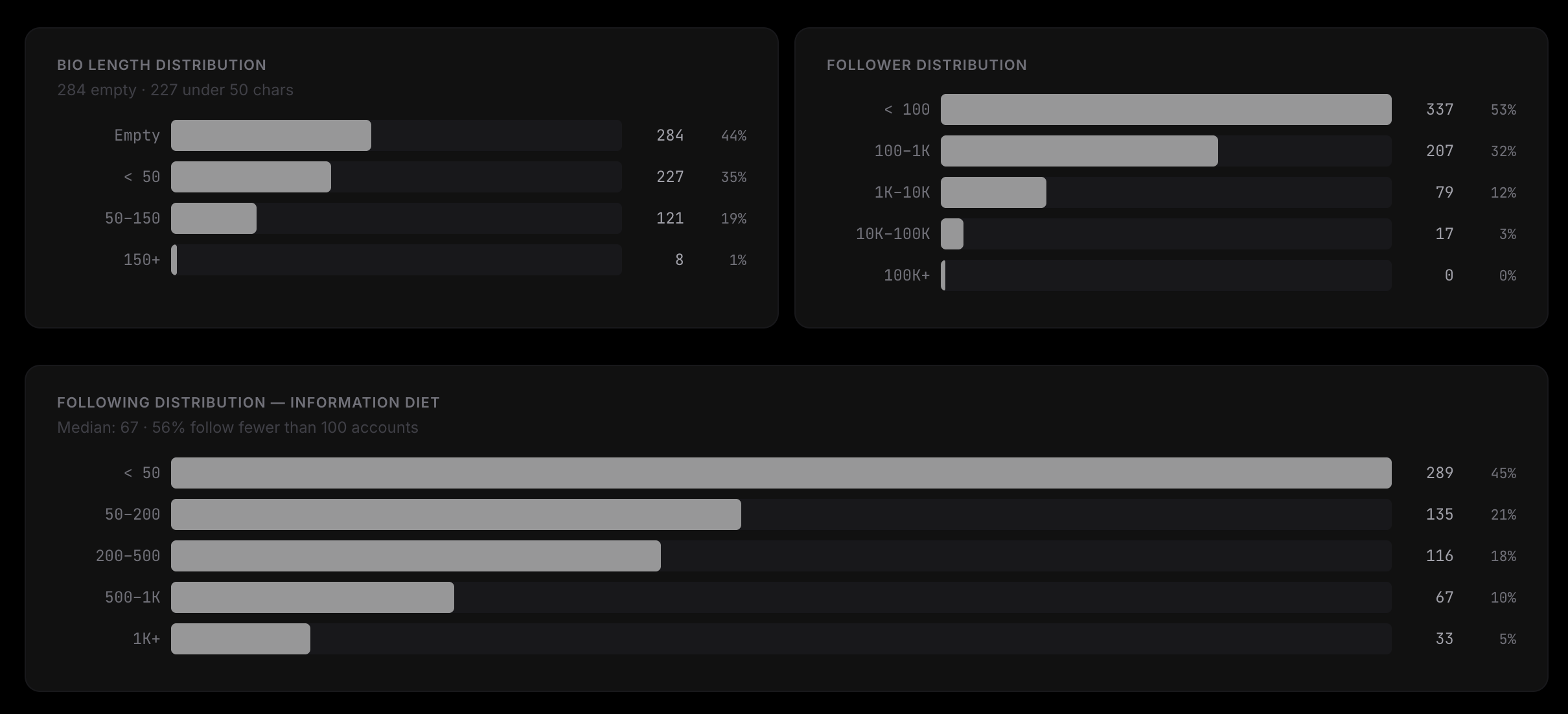
*Fig 2 — Bio length, follower count, and following count (information diet).*
But that "eight in ten are minimal" is **easy to misread** — it sounds like "these people are lazy or bad at this." I think the truer reading is the opposite: **they don't need to package themselves.**
For someone at xAI, the handle plus the word "xAI" is already the best business card. Whether the bio is filled out, whether they "do social" well — none of it matters to them. An empty bio here isn't an oversight; it's the confidence of having nothing to prove.
### And clicking through, I got a little envious
I came in carrying anxiety; but opening each profile one by one, I found that they not only don't bother with X — they also seem to be living pretty relaxed, happy lives. In that moment the anxiety turned into a bit of envy — and what I envied wasn't the easy life. It was that they don't spend a single second proving themselves.
### And they cluster where the work is
Just under half list a location at all — the other **55% leave it blank**. Of the ones who do, it's overwhelmingly the **Bay Area** (Palo Alto, San Francisco, Mountain View), with a small **Memphis** cluster — where xAI's Colossus supercomputer sits — and a London pocket. The map of this group is basically the map of where the compute is.
### The ones with a story tag their school, their big-tech past, their PhD
When people do mention their background, many @ their school (usually a top one), or the FAANG-tier company they came from, or the PhD.
Those tags only show up among the people who bothered to write a bio at all — top schools, big-tech pedigree, PhDs. Which cuts the other way: the ones listing their credentials are the small group who still feel they have something to prove. Everyone else skips even that.
## One more thing: they rarely "broadcast"
Lay out everything this group posted in the last 30 days — 4,321 posts, 144 a day on average. Sounds like a lot. But break it down by type and it gets interesting: **only 10% are original posts.** The rest are replies (48%), reposts (30%), and quotes (12%).
In other words, even when this group is active on X, they're mostly *responding* to others and *resharing* others — not *broadcasting* their own. Which lines up with the map: pure broadcasters are only 1%. A group handed megaphones, standing at the frontier of AI, mostly chose to listen rather than talk.
## So — where does the influence come from?
That was my second question, and the follow graph starts to answer it.
I pulled the full following lists for a sample of the cohort and ranked every account by how many of them follow it — a rough map of who this group collectively pays attention to. I expected AI Twitter: the famous researchers, the lab founders, the threads I read myself. That is not what sits at the top.
At the top are two things: **their own colleagues, and Musk's operational orbit.** The most-followed accounts inside the group are other xAI people — and right behind them, SpaceX, not AI. Michael Nicolls and Gwynne Shotwell (SpaceX's president) rank above almost every outside AI researcher. Other frontier labs barely register.
The raw numbers have a twist, too. Individually, their diets point *outward* — only about **14% of who they follow is inside xAI**. But collectively the attention piles back onto a small internal core. Diffuse one by one; concentrated as a group.
So here is the model I walked away with:
**At a frontier lab, influence isn't a follower count — it's an inward-facing, founder-gravitational graph.** The signal circulates among colleagues and the founder's real-world orbit. It doesn't broadcast out to the public "AI discourse" you think you have to break into.
Which flips the usual advice. If you're on the outside trying to get noticed — posting hot takes into the void, farming an AI-Twitter following — you're optimizing the wrong map. The people you want to reach aren't listening outward. They're heads-down, following each other and the mission.
That's the thread I'm still pulling: who the real hubs are, how tight the core is, whether every lab is shaped the same way. Because a frontier AI lab in 2026 is Binance in 2017 — and at the top of the gale, the thing worth knowing is who, behind that door, actually calls the shots.
I want to know more.
*(By the way: I turned this whole "drop in a list, watch how it really behaves" approach into something that runs on any list. But that's another story.)*
## References
- The tweet that started all this — [x.com/deedydas](https://x.com/deedydas/status/2068238634600554699)
- Why this seat matters to me: "Their floor was our ceiling" — [x.com/0xHoward_Peng](https://x.com/0xHoward_Peng/status/2057837810548420731)
- xAI's official affiliates list — [x.com/xai/affiliates](https://x.com/xai/affiliates)
- The four patterns, as I first mapped them — [x.com/0xHoward_Peng](https://x.com/0xHoward_Peng/status/2069638421623284086)