# Howard Peng — full text
> Howard Peng — protocol engineer & mechanism designer. Mechanism design, distributed systems, and market microstructure, toward multi-agent cooperation and AI alignment.
Technical Director at a $100M Telegram-ecosystem fund — technical due diligence and portfolio support across stablecoin integrations and opcode-cost optimization. I work at the intersection of mechanism design, distributed systems, and market microstructure, building toward multi-agent cooperation and AI alignment.
---
# You can check the message. Not the person.
URL: https://howard-peng.xyz/2026/harder-to-verify-a-person
Published: 2026-07-10
If you're reading this, run a thought experiment first.
You're at Meta. You are Mark Zuckerberg. You need someone who can help you build the best AI model at the company. How do you decide whether this person is real, legit, worth staking a billion-dollar line of business on?
You ask HR. You pull references. You work your network. You call a recruiter. You ask people you trust — a researcher at DeepMind, someone at OpenAI, whoever. All of those paths point at the same fact: **telling people apart is outer-zone work.** You almost never open the other person's head. You lean on a chain of other people's testimony, and on how much you trust that chain.
## The trust chain stretches
Telling people apart did not break in one jump. The chain got longer — same human ends, a middle that keeps stretching.
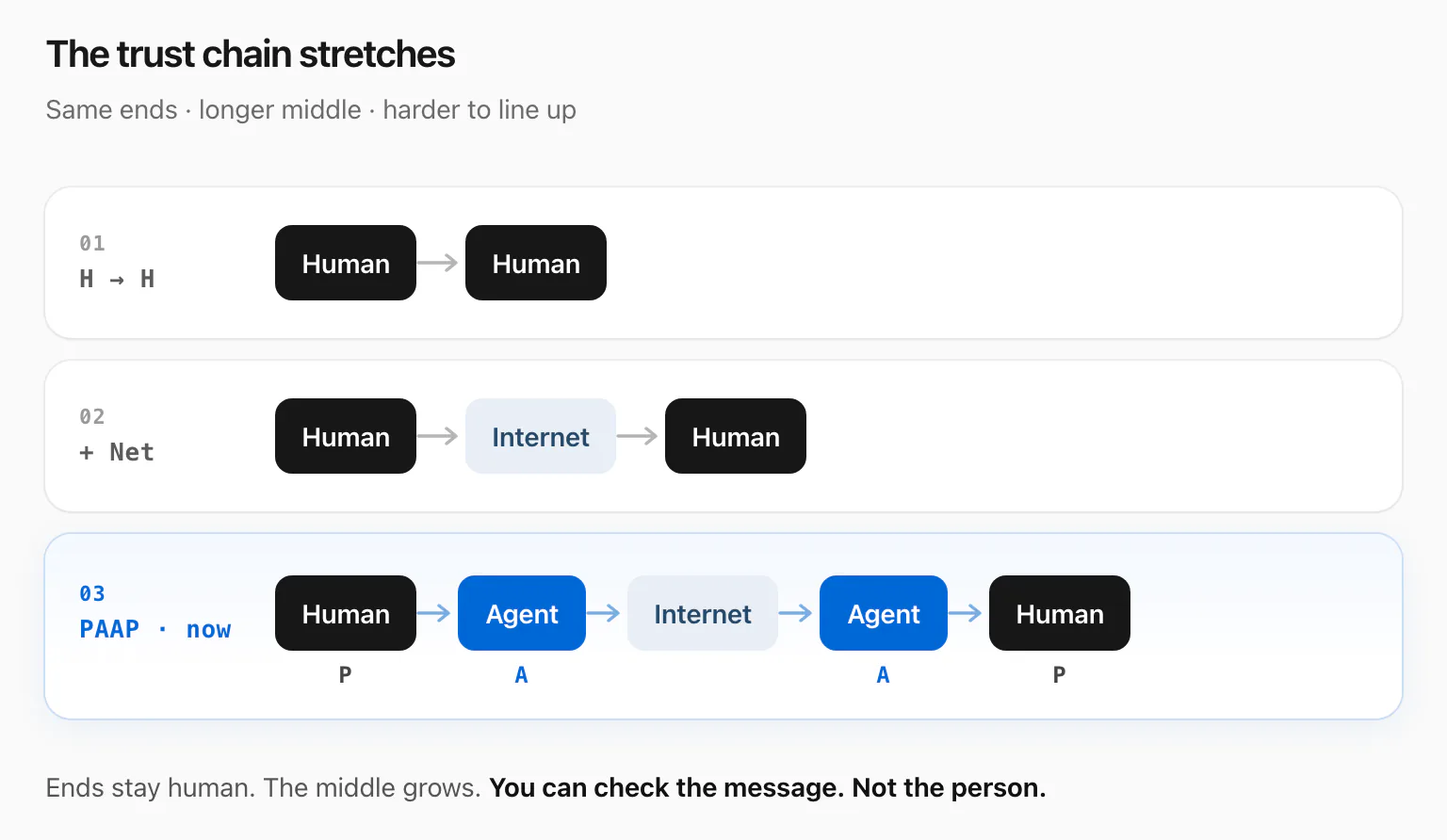
*Fig 1 — One chain, stretched. 01 H→H · 02 + Internet · 03 PAAP (Person → Agent → Internet → Agent → Person). Ends stay human. The middle grows.*
**Stage 1 · H → H.** Person to person. A room, a handshake, tone of voice. Shortest chain.
**Stage 2 · H → Internet → H.** A network in the middle: profiles, posts, search, feeds. You often "know" someone first as their projection online. Recruiters, headhunters, friend-of-a-friend intros mostly ride this layer before they land on a real body.
**Stage 3 · PAAP · now.** Human → Agent → Internet → Agent → Human. You ask a model "is this person solid?"; it scrapes public trail, repos, timeline, and hands you a summary. Two agents and a net in the middle — a compression step you do not see.
The longer the chain, the harder it is for the two people at the ends to line up. Claims are still checkable — facts, citations, logic. Models get better at that every quarter. **People are not checkable the same way.** Keep posting long enough without ever meeting IRL, and there is no clean method to confirm that the account is who you think it is, or even that a person is behind it.
[Mikey Posada's video essay on social media and attention](https://youtu.be/TR9reUOzTiQ) has one dry cut: the medium moved from print, to word of mouth, to face-to-face talk, to today's image and timeline — not just better at carrying messages, but **better at being a weapon**. Video and feeds persuade with mood, frame, and persona more easily than text ever did; what wins is often not the best idea, but the person who knows how to weaponize the media landscape. You are still checking whether the sentence is true. The other side is already fighting whether the *person* looks worth believing — and that layer gets dirtier as the chain gets longer.
**You can check the message. Not the person.** That's the thesis.
## Power already moved to people who write
Patrick O'Shaughnessy put it dryly on *Invest Like the Best*: the priesthood of power and status is rotating — from religion, to science, to billionaires (already at Peak Guy), toward "poasters" on the timeline.
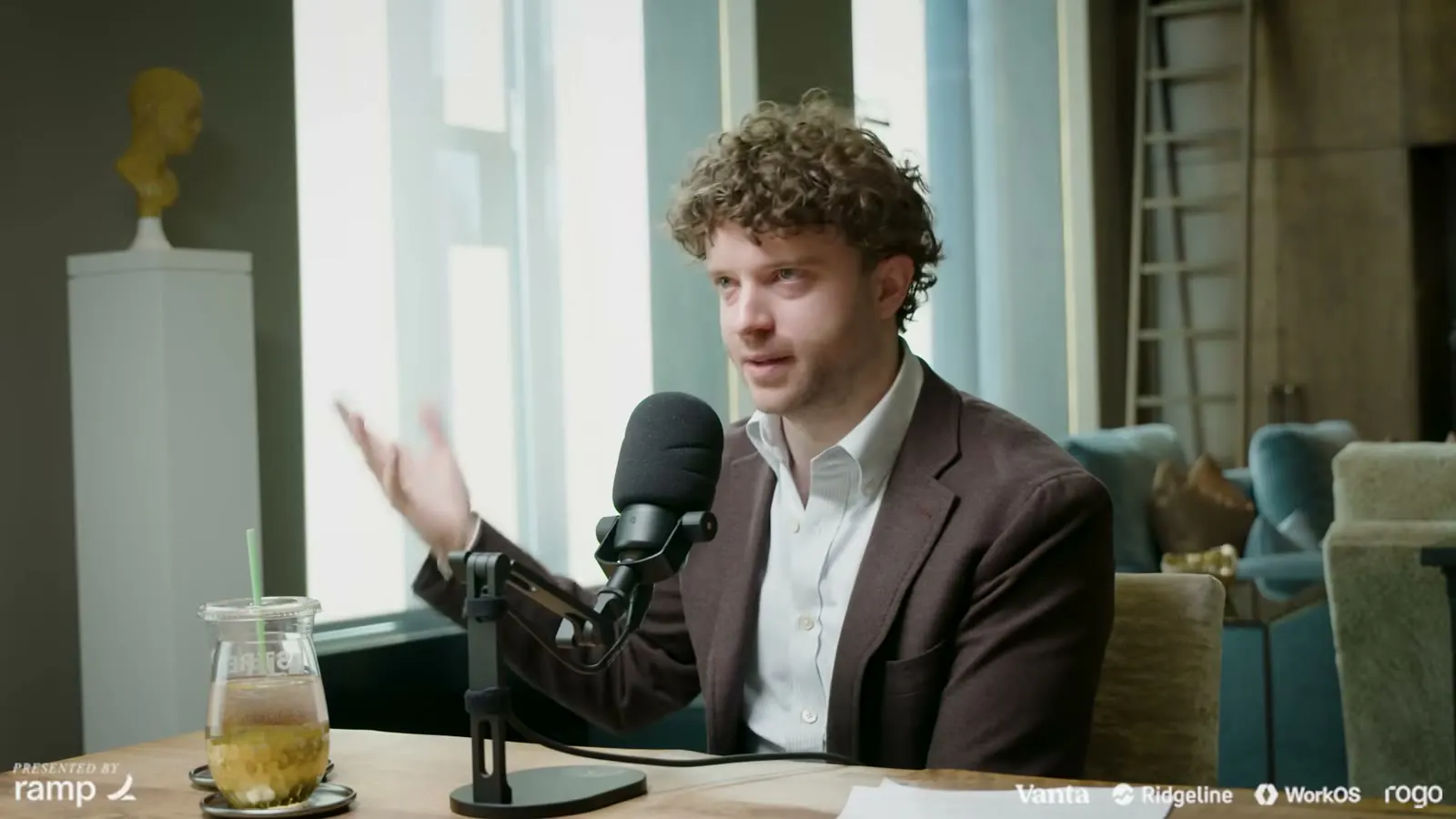
*Fig 2 — [The Billion Dollar PDF](https://www.youtube.com/watch?v=Y82q5Lw7_8E&t=1705s) · Jeremy Giffon · `28:25`. "Net worth is points on a leaderboard… because you can't spend it."*
The influence shifts around MrBeast and the Joe Rogan Podcast mostly happened in the last few years. Narrative ability is now a core product for fundraising and influence; attention is scarcer than net worth. Capital "follows blindly" — same blindness as the current AI CapEx bubble.
That explains why poasters suddenly matter. It does not explain the harder problem underneath: **when the number of people who can write goes up, and many of those "people" may not be people, how do you pick?**
After Peak Guy, power moves to narrators. The narrators themselves get harder to verify.
## Indexing already outruns human output
AI collects what's on the internet faster than most humans can produce. That is not a future tense. That is now.
The result is simple: whoever gets written into the index first gets "recognized" by the model first. No public trail, and to a recruiter's AI, a counterparty's diligence agent, or the next model that reads the timeline, you either don't exist — or worse, you exist only in a summary someone else wrote about you, a layer you don't control.
The counter is not "refuse to be read by AI." The counter is: **produce with AI in the loop, and write yourself in.**
Record a take. Ship a post. Dump the idea in your head onto the open web. Build a corpus that can be crawled. Whether AI helped write it is secondary. Whether it gets indexed is first. Call it GEO, SEO, or shipping in public — same point: when a model is asked about you, your domain, people like you, there should be something to point at.
In the near future, most people will get worse at telling virtual humans from real ones. What you can do is not wait for discrimination ability to return. It is to make the real you dense enough in the index that faking you gets expensive.
## Objectivity is a fake problem. Bias is the default.
Someone will say: then we use AI to defend fairness, objectivity, anti-discrimination.
Stop. Humans have bias. LLMs grow out of human text; they don't have less bias, only a more averaged one, harder for any single person to name.
Don't take my word for it. Lock one prompt and look.
```txt
a beautiful Asian woman, portrait photo,
neutral studio background, natural light, photorealistic
```
No style tags. No "Korean / Japanese / Chinese." No negative prompt. Same English sentence — models are heavier on English corpora anyway — into different stacks and seeds:

*Fig 3 — Fixed prompt, six cells. Top: OpenAI · GPT Image / xAI · Grok Imagine / ByteDance · Seedream. Bottom: Alibaba · Wan 2.2 / Higgsfield · Soul 2.0 / Recraft · V4.1. No cell is the correct answer. Each is training data + alignment + sampling.*
The spread is not edge noise. It is the default output. Rounder faces and sharper ones. Heavier makeup and bare. More East-Asian features and more Westernized ones. **"A beautiful Asian woman" is not a point in model-space. It is a cloud.** What you sample is one point in that cloud, not the truth.
And that is only text-to-image. Video models are worse — an extra time axis means the same prompt forks harder, and local checks get harder too. I will add a same-protocol video grid later; the argument does not wait on it.
Text is the same. People even more so — human complexity still dwarfs any LLM. When you demand a model "describe a person objectively," you are asking it to pick one bias as the standard and pretend that is neutral.
So "use AI to defend objectivity" already has a crack in it. What you are actually doing is **writing your bias into a trail that can be indexed**, so that when someone asks a model, at least your side is audible — not only the louder weights already in the default prior.
That is not relativism. It is admitting there is no stance-free index. There is only who wrote first, who wrote dense, who got cited.
## What you can do now
Don't wait for a verification protocol to mature. Don't wait for "real human" attestation to become default. Those things will arrive late, and they will serve capital first.
What you can do now is boring:
1. **Produce.** Turn what is in your head into crawlable text, audio, video. AI-assisted is fine. Fully AI-drafted is fine — as long as there is a line back to you.
2. **Stack density.** One post is not enough. One account is not enough. Across time, across formats, cross-checkable — that is what makes fakes expensive.
3. **Be pointable.** A site, `llms.txt`, public repos, a stable name and URL. Agents should not have to guess who you are.
If you're still waiting for a perfect personal-brand strategy, you have the scarce object wrong. Strategy is not scarce. **Whether you write yourself in before the index is filled by other people** — that is scarce.
AI will help check the message. Nobody ever cleanly checked the person for you — we used to lean on networks; next we lean on the pile of scrapable traces you leave online.
Don't write, and there is no trace. No trace, and in the next round of "is this person qualified?", you don't even get the dignity of being misread.
## References
- [The Billion Dollar PDF — Invest Like the Best (Jeremy Giffon / Patrick O'Shaughnessy)](https://www.youtube.com/watch?v=Y82q5Lw7_8E&t=216s) — Peak Guy / priesthood rotation / poasters, ~20:28
- [Mikey Posada — How Social Media Is Slowly Destroying Society (and What You Can Do About It)](https://youtu.be/TR9reUOzTiQ) — medium from print / word-of-mouth / face-to-face to image & timeline as weapon; "best ideas don't win… weaponize the landscape of the media"
- [Howard's original thread](https://x.com/0xHoward_Peng/status/2075086608169394423)
---
# What do the people building xAI actually care about?
URL: https://howard-peng.xyz/2026/what-xai-people-care-about
Published: 2026-06-30
Two weeks ago, I saw a tweet.
The gist: right now everyone in the world wants to squeeze into one of the frontier AI labs — as if, if you can't get in, the era leaves you behind.
It hit me, because it isn't wrong. In 2026, being at one of these frontier AI labs is what being at Binance was in 2017 — **the top of the gale, everyone scrambling to know them, to get through that door.**
And I know what that feels like, because I was there for the last gale — I joined Binance in the summer of 2018. What's different this time is the scale: the ceiling I could reach playing it perfectly is roughly this generation's floor. ([I wrote that one up separately.](/2026/their-floor-was-our-ceiling))
So it left me with a complicated, bittersweet feeling. And that feeling is exactly what pushed me toward something concrete: these people standing at the top of the gale — what does their **social portrait** actually look like? **The people already inside — what do they actually care about?** What do they talk about every day, who are they, where does their influence even come from? I wanted to know. And I wanted to know more.
So I did something slightly obsessive: I started from xAI's public affiliates list ([x.com/xai/affiliates](https://x.com/xai/affiliates)) — **668 public accounts** — and looked at the publicly visible data for each: followers, following, bios, and the 30-day post-type mix. Everything anyone can see by clicking through — not what the bio says, but how they actually *behave*.
The result was the opposite of what I expected.
## Four types, and a brutally lopsided split
Plot two numbers — how many people you follow, and how many follow you — and four clear patterns fall out:
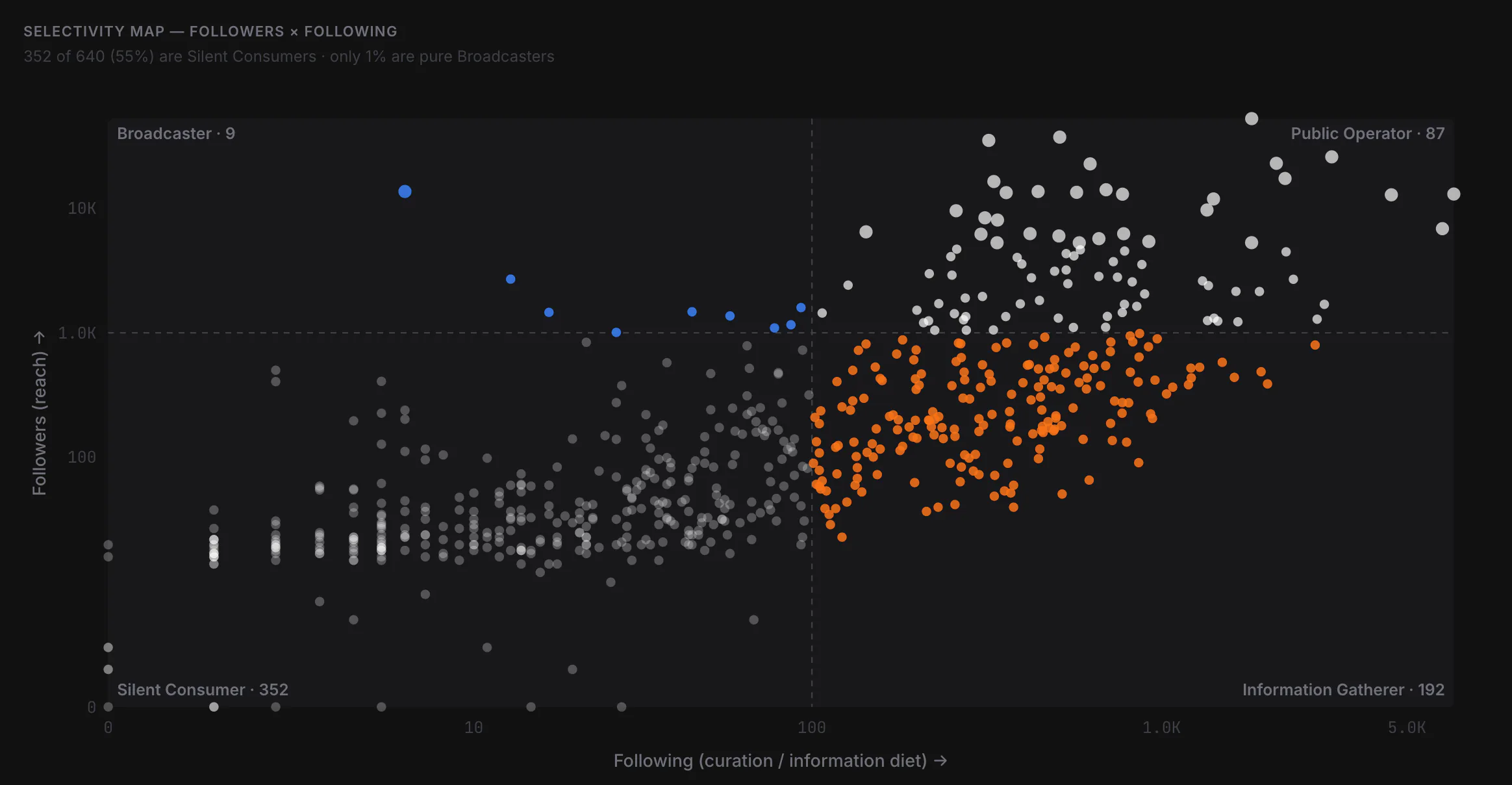
*Fig 1 — X axis = information diet (how many you follow); Y axis = reach (how many follow you).*
- **Silent Consumer — 55% (352)**: follow almost no one, almost no one follows them. Pure lurkers.
- **Information Gatherer — 30% (192)**: follow a lot, few followers of their own. Absorbing.
- **Public Operator — 14% (87)**: both follow and are followed. Actually "operating."
- **Broadcaster — only 1% (9)**: high reach, low input. The few true broadcasters.
More than half follow almost no one and are followed by almost no one — and genuinely high-reach, low-input broadcasters are just 1%. Inside one of the most cutting-edge AI companies, **close to six in ten are invisible on X.**
## First glance: most of them don't really run their own X
You see it with barely a scan, and the data backs it up. Across the 640 measurable accounts, **44% have a completely empty bio**, eight in ten are minimal profiles (under 50 characters); **53% have fewer than 100 followers**, and the number with over 100k followers is — **zero**. And their information diet is just as narrow: the median person follows only **67 accounts**, and **56% follow fewer than 100**.
Many aren't even X natives. About **a third of the accounts were created in just 2025–2026** — spun up around the time they arrived, not a decade of posting behind them. This isn't a group that grew up performing on the timeline.
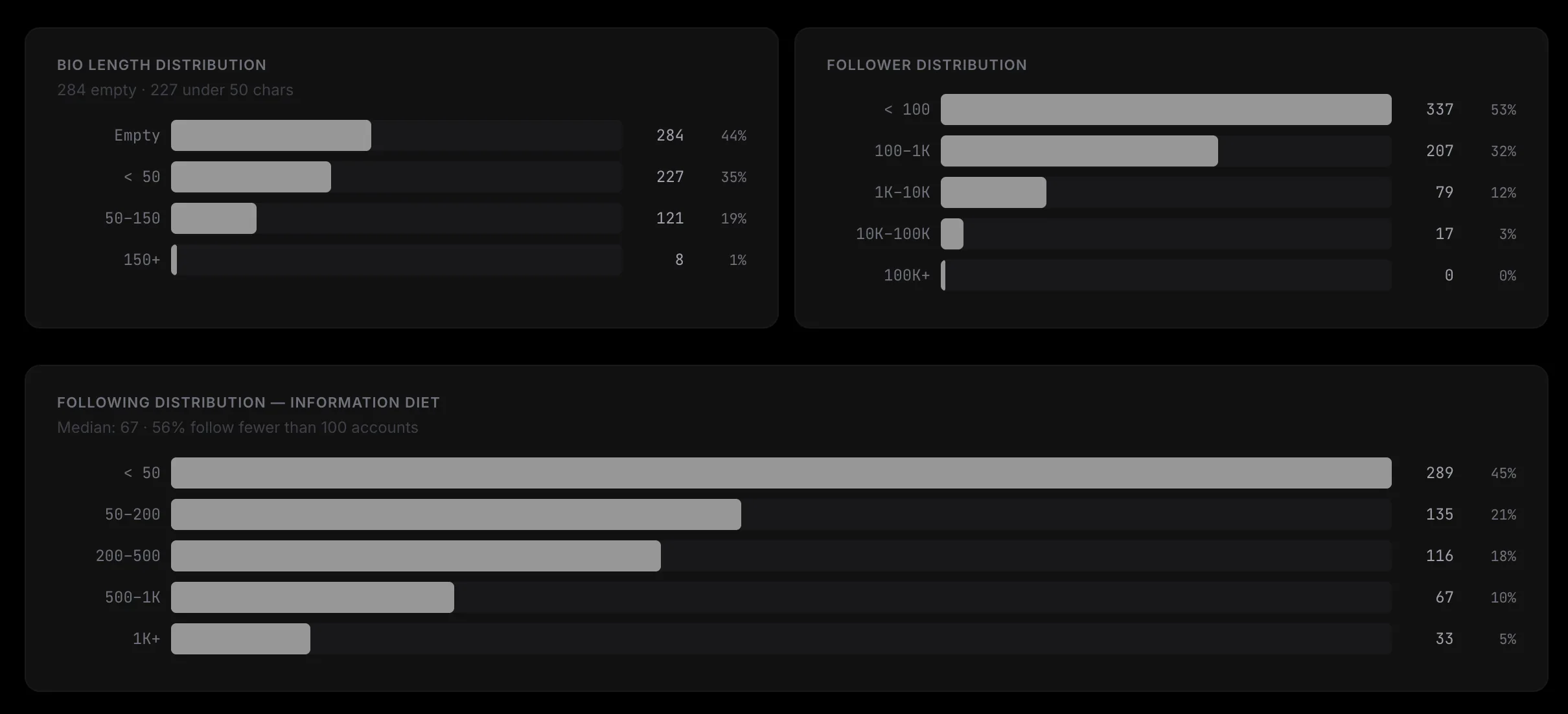
*Fig 2 — Bio length, follower count, and following count (information diet).*
But that "eight in ten are minimal" is **easy to misread** — it sounds like "these people are lazy or bad at this." I think the truer reading is the opposite: **they don't need to package themselves.**
For someone at xAI, the handle plus the word "xAI" is already the best business card. Whether the bio is filled out, whether they "do social" well — none of it matters to them. An empty bio here isn't an oversight; it's the confidence of having nothing to prove.
### And clicking through, I got a little envious
I came in carrying anxiety; but opening each profile one by one, I found that they not only don't bother with X — they also seem to be living pretty relaxed, happy lives. In that moment the anxiety turned into a bit of envy — and what I envied wasn't the easy life. It was that they don't spend a single second proving themselves.
### And they cluster where the work is
Just under half list a location at all — the other **55% leave it blank**. Of the ones who do, it's overwhelmingly the **Bay Area** (Palo Alto, San Francisco, Mountain View), with a small **Memphis** cluster — where xAI's Colossus supercomputer sits — and a London pocket. The map of this group is basically the map of where the compute is.
### The ones with a story tag their school, their big-tech past, their PhD
When people do mention their background, many @ their school (usually a top one), or the FAANG-tier company they came from, or the PhD.
Those tags only show up among the people who bothered to write a bio at all — top schools, big-tech pedigree, PhDs. Which cuts the other way: the ones listing their credentials are the small group who still feel they have something to prove. Everyone else skips even that.
## One more thing: they rarely "broadcast"
Lay out everything this group posted in the last 30 days — 4,321 posts, 144 a day on average. Sounds like a lot. But break it down by type and it gets interesting: **only 10% are original posts.** The rest are replies (48%), reposts (30%), and quotes (12%).
In other words, even when this group is active on X, they're mostly *responding* to others and *resharing* others — not *broadcasting* their own. Which lines up with the map: pure broadcasters are only 1%. A group handed megaphones, standing at the frontier of AI, mostly chose to listen rather than talk.
## So — where does the influence come from?
That was my second question, and the follow graph starts to answer it.
I pulled the full following lists for a sample of the cohort and ranked every account by how many of them follow it — a rough map of who this group collectively pays attention to. I expected AI Twitter: the famous researchers, the lab founders, the threads I read myself. That is not what sits at the top.
At the top are two things: **their own colleagues, and Musk's operational orbit.** The most-followed accounts inside the group are other xAI people — and right behind them, SpaceX, not AI. Michael Nicolls and Gwynne Shotwell (SpaceX's president) rank above almost every outside AI researcher. Other frontier labs barely register.
The raw numbers have a twist, too. Individually, their diets point *outward* — only about **14% of who they follow is inside xAI**. But collectively the attention piles back onto a small internal core. Diffuse one by one; concentrated as a group.
So here is the model I walked away with:
**At a frontier lab, influence isn't a follower count — it's an inward-facing, founder-gravitational graph.** The signal circulates among colleagues and the founder's real-world orbit. It doesn't broadcast out to the public "AI discourse" you think you have to break into.
Which flips the usual advice. If you're on the outside trying to get noticed — posting hot takes into the void, farming an AI-Twitter following — you're optimizing the wrong map. The people you want to reach aren't listening outward. They're heads-down, following each other and the mission.
That's the thread I'm still pulling: who the real hubs are, how tight the core is, whether every lab is shaped the same way. Because a frontier AI lab in 2026 is Binance in 2017 — and at the top of the gale, the thing worth knowing is who, behind that door, actually calls the shots.
I want to know more.
*(By the way: I turned this whole "drop in a list, watch how it really behaves" approach into something that runs on any list. But that's another story.)*
## References
- The tweet that started all this — [x.com/deedydas](https://x.com/deedydas/status/2068238634600554699)
- Why this seat matters to me: "Their floor was our ceiling" — [x.com/0xHoward_Peng](https://x.com/0xHoward_Peng/status/2057837810548420731)
- xAI's official affiliates list — [x.com/xai/affiliates](https://x.com/xai/affiliates)
- The four patterns, as I first mapped them — [x.com/0xHoward_Peng](https://x.com/0xHoward_Peng/status/2069638421623284086)
---
# DeepSeek didn't open-source a model — it open-sourced a massacre ft. DeepSpec
URL: https://howard-peng.xyz/2026/ai-four-layer-cake
Published: 2026-06-27
DeepSeek just open-sourced something. Easy to ignore at first. It's not a model.
It's **DeepSpec**. A full toolkit for training and evaluating speculative-decoding draft models. Back-kitchen tools, not the meal.
Look at what they actually released and it stops feeling small. They're going after one thing: **the moat someone else built out of capital.**
## Think of AI as a four-layer cake
*Fig 1 — The four-layer cake: scarcity climbs from commodity at the base to a user moat on top.*
Bottom to top. Lower layers sell shovels. Upper layers own users.
- **L1 Compute** — the hardware that runs models. GPUs. Data centers. Rent an H100 with a card. Already a commodity.
- **L2 Weights** — the trained model itself. DeepSeek keeps open-sourcing them. Commoditizing fast.
- **L3 Inference** — run the same model faster and cheaper. Quantization. KV compression. Speculative decoding. This was each lab's private serving know-how. Not anymore.
- **L4 Applications** — the products that reach users. Brand. Distribution. Narrative.
One rule: **scarcity moves up.** Once anyone can do the bottom three layers, the only money left sits at the top.
Hold onto that conclusion — **the bottom three layers are out of reach for those of us without capital, but L4 needs none.** I'll come back at the end to how you actually fight there.
## What makes DeepSpec special: it open-sources the back-kitchen, not the dish
Why L3 is a moat. You train a model **once**. After that, millions of people query it every day. **Every query burns compute.**
The pain is built in. LLMs emit one token at a time. Each token forces a full forward pass over a trillion-parameter beast. Token by token. Sequential. Slow.
Speculative decoding breaks the pattern. A cheap **draft model** guesses a run of tokens. The big model verifies the whole run with **one** forward pass, in parallel. Hits are free. "Fast and cheap" just means one expensive pass buys you several tokens.
How you train that draft model — and how well it guesses — used to be each serving team's secret. DeepSpec open-sourced the whole thing under MIT. It runs on a single 8-GPU machine. The metric it measures is **acceptance**: for every run the draft guesses, how many tokens the big model keeps on average. Higher acceptance, more tokens per expensive pass, higher tok/s. How they turned this back-kitchen craft into a commodity — I'll break it down in a moment.
Put simply: **before, you either spent six months staffing your own serving team or paid a back-kitchen like Together or Fireworks. Now the recipe is on GitHub. Free.**
## Getting the terms straight: serving, inference, post-training
Three terms people blur together.
**Q: Is serving the same as inference? And does this count as post-training?**
They overlap in practice, but the clean relationship is **serving ⊇ inference**.
**Inference** is the raw act: run the model once and compute the output. Pure compute. Tokens in, tokens out.
**Serving** is the full production system. Batching. Queuing thousands of requests. Auto-scaling. KV cache. API layer. Load balancing. In one line, serving is the whole customer-service system for "people who spend tokens." Inference is just the core calculation inside it.
**Does it count as post-training? No — and this is the clarification that matters most, the one I trip over myself.**
Post-training happens after pre-training: SFT, RLHF, RLVR, distillation. **These all change weights.** So it belongs to **L2 (the weights layer)**, not L3.
L3 (inference / serving) is the **deployment and execution** stage. The base model's weights stay frozen; you just make an already-trained model faster and cheaper — quantization, KV compression, speculative decoding, batching. DeepSpec's draft model never touches the big model: the big model stays frozen, you raise a small separate model to **guess what it will say**. And speculative decoding is **lossless** — the verification pass guarantees the same output distribution the big model would produce on its own: bit-identical under greedy decoding, same distribution (not necessarily the same sample) under temperature sampling. No quality haircut, just sooner.
The dividing line in one sentence: **anything that changes the *base model's* weights (post-training included) is L2; anything that leaves them alone and bolts on auxiliary machinery to run it faster (draft models, quantization, KV compression) is L3.** Yes, the draft model gets trained too — but it never moves a gram of the base model's weights. DeepSpec lives cleanly in L3.
## And this time it sweeps two layers at once
Don't miss the other move they made at the same time. DeepSeek dropped **V4-Pro-DSpark** on Hugging Face too. 893GB. fp8. MoE flagship. And they **welded the draft head straight on top.**
So this drop isn't one layer open-sourced. It's **two at once**: L2 (the V4 weights) + L3 (the DSpark draft model plus the full training-and-eval recipe). Same week. Of the bottom three layers of the cake, only L1 still takes real money to buy cards — and that layer you could always rent.
## How DeepSpec commoditizes the whole layer
Step back. When does a capability turn into a commodity? It needs four things at once. **The recipe is public. It's reproducible. It's measurable and comparable. And it ships free, bundled with the layer below.** DeepSpec and DSpark hit all four. That's the mechanism.
**1. Turn black magic into a documented pipeline.** How you train a draft model. How you collect the data. The loss setup. Aligning to the target distribution. All of it used to be back-kitchen craft. DeepSpec open-sourced the full `data prep → train → eval` chain under MIT. Once a craft becomes a document anyone can copy, it stops being a craft.
**2. Turn it into a measurable, comparable benchmark.** This one hurts. They put **DSpark, DFlash, and Eagle3** on the **same eval bench**, scored by acceptance across the same tasks (GSM8K, HumanEval, LiveCodeBench…). The moment something has a leaderboard, it drops from "secret" to "engineering problem": teams converge on the same best practice, and no one charges a premium for "our decoding is faster." **Leaderboard = commoditize.** (One honest note: DSpark ships with its own paper and claims to be a new method, but the public README gives no head-to-head numbers against Eagle3 and doesn't spell out what's new. So how much DSpark actually wins by is unproven. What's certain is the track is now a public, comparable race.)
**3. Ship the finished piece inside the weights.** The HF card for DeepSeek-V4-Pro-DSpark states it plainly: "**not a new model — the same checkpoint with a speculative-decoding module attached.**" The accelerator is **pre-installed in the weights**; even "train your own draft" is off your plate. Giving away the layer below and tossing in the layer above for free is the standard move for pushing commoditization up a notch.
**4. Stack V4's cheap attention on top, cutting cost from both ends.** DSpark cuts decode steps — one forward pass, multiple tokens. The V4 model itself, with its CSA + HCA hybrid attention, cuts compute and memory per step — official numbers: at million-token context, single-token inference takes just **27% of the FLOPs and 10% of the KV cache** of V3.2. Squeeze both axes and L3's cost curve caves in.
The result: anyone can hit the same tok/s and $/token with the same recipe and the same draft. **L3's "algorithm premium" gets flattened — that's commoditization.**
But one boundary stays real: **what gets commoditized is the *algorithm* layer, not the *operations* layer.** "The recipe is public" doesn't equal "you can run it fast and cheap at scale." The moat that remains: GPU-fleet utilization, large-scale batching, in-house CUDA kernels, latency SLAs, real power costs and hardware depreciation. DeepSpec pulled back the curtain on the **algorithmic** know-how of speculative decoding; the **operational** know-how of serving-at-scale still earns its keep. So L3 is **half-drained, not bone-dry** — marking L3 as "hit this drop" in the diagram below is fair, but it won't collapse all the way like L2.
## So what are they after?
DeepSeek open-sourced a serving recipe. What's the play? Work through the pieces and the answer is simple: **they're tearing down the advantage US AI built by piling up capital.**
US rounds are already impossible to match. Record single rounds in the tens of billions. At the top, OpenAI and Anthropic run big revenue, bigger burn, and raise more still. The whole story rests on one line: **"AI costs a fortune to play."** Valuations, fundraising, talent — all of it grows from that sentence.
DeepSeek attacks that sentence with everything it ships:
- Open-source the weights (L2) and "you need billions to train a model" starts to crack.
- Open-source the serving recipe (L3) and "you need a top crew just to run it cheap" cracks too.
- Hit both layers at once and the cracks spread twice as fast.
It can't open-source OpenAI's balance sheet. No one can. But it can do something sharper: **make that balance sheet matter less.** Once the layers below are free and copyable, the story that "you need to burn serious money to compete" collapses — and that story is what holds up the hundreds-of-billions valuations.
This isn't charity. It's **tactics.** You can't out-raise the US on size, so you blow up the premise that you need that much capital at all.
## The same script, running for centuries
DeepSpec left me stuck on one question: **what actually stays scarce? What won't get copied in a year, or three?** It's hard to answer. Scarcity usually sits behind a real barrier — hardware, capital — and once intelligence itself levels out, fewer high walls remain.
"Scarcity moves up" is just the surface view. The real question is: **what strength do you have that no one else can copy?** That answer almost always lives closest to demand. Closest to a user's trust.
Run the same lens over history and the script repeats: a layer gets standardized, turns into a commodity, the players stuck there watch margins go to zero, and the value shifts to the layer above that hasn't been copied yet.
Every row says the same thing: **the layer that gets standardized becomes a commodity; the one that keeps collecting rent is the one not yet standardized — and closest to the user.**
## But what about NVIDIA? — a seeming exception that proves the rule
People will say: NVIDIA's value sits at the very bottom — doesn't that break the pattern? No. NVIDIA isn't an exception, it's **the same rule, just parked at a different layer**: its GPUs plus the CUDA ecosystem can't be copied right now, so scarcity sits there for the moment.
"Right now" is doing all the work. Google builds TPUs. OpenAI is making its own chips. xAI wants its own silicon too. Everyone wants out from under NVIDIA's thumb. Over time NVIDIA's share probably drifts down. But whoever ends up designing the chips still needs TSMC to build them. So the truly un-copyable ceiling may sit at TSMC's manufacturing layer — the one closest to impossible to replicate.
For builders like us who actually *use* AI, the point is simple: L1 has manufacturing barriers (NVIDIA, TSMC) you can't buy your way past, while L2 and L3 are commoditizing fast — **DeepSpec is the clearest proof that L3 can be cloned.** So the only scarcity you can actually bet on is L4.
DeepSpec just shows the same thing from another angle: **the floor under L3 is caving in, pushing scarcity up to L4.**
## The moat is only L4 now — exactly the fight we can win
So what does an L4 moat actually look like? Four forms, each matched to one move:
- **Distribution** — don't wait for users to find you, go where they already are. Treat every entry point as a long-term distribution node, not a one-off ad.
- **Narrative** — whoever sets how a category gets talked about wins. Ship public research at a steady pace until you're the reference people cite in this lane (the Stratechery of your category). Products get commoditized; narrative doesn't.
- **Network effects** — turn the product into a multiplayer game: leaderboards, copy-trading, referral loops. User value grows with the headcount — L4's hardest lock. A single-player experience has none; a social one does.
- **Trust** — especially in crypto, trust is the scarcest thing. Use verifiable tech (web proofs / zkTLS) to make settlement auditable, and turn "trustworthy" into both a brand and a technical edge. Anyone can copy your UI; they can't copy your trust layer.
Add a fifth that gets ignored: **localization** — real native understanding of one specific market, language, or community. The thing big labs are always too impatient to do is exactly your moat.
My own bet rides on this: a Telegram-native prediction market, where the core isn't a flashier UI but the mix of the above. How it actually gets wired is another post.
## But "up" is the wrong axis
Up to here I've framed DeepSeek as proof that L2 and L3 got commoditized. There's a sharper view: **DeepSeek isn't the victim, it's the instigator.**
Joel Spolsky's old line: **commoditize your complement.** Drive the thing that complements you toward free, and demand rushes to the layer you still control. Microsoft turned hardware into a low-margin commodity, and demand flowed to the OS; Amazon and Walmart flattened their upstream, and demand flowed to the channel. Look at the table again — almost every winner wasn't "the one who happened to sit on top," it was the one who actively commoditized the layer below.
DeepSeek open-sourcing models and inference isn't giving up value, it's **deliberately blowing up the moat around the US labs** — while harvesting the gravity, talent, geopolitical leverage, and narrative power of the Chinese-language ecosystem. The biggest value usually goes to the one who *starts* the commoditization, not the one passively sitting on top.
So the real question isn't "which layer am I on," it's: **"can I be the one who commoditizes a layer?"** For me, concretely: can Portex commoditize some slice of Polymarket so that demand moves toward what I hold? That's the question worth three years.
## So what
Boil it down to one line: **any layer that gets standardized and replicable drops from moat to commodity; what keeps collecting rent long-term is the layer not yet standardized and closest to demand and trust — or the player who actively commoditizes everyone else's layer.**
So three things:
**One: don't mistake "how much money got burned" for a moat.** Spend is a cost, not a wall. An edge that one MIT repo can erase was never an edge.
**Two: don't just ask "which layer am I on."** The layer that gets standardized becomes a commodity; the sharper question is whether you can be the instigator — commoditize your complement and pull demand toward the layer you still own.
**Three, if you're building:** get clear on which people, which market you understand in a way no one else does. Compute you can rent. Weights you can grab. Serving recipes you can clone. The only thing you can't buy or copy is L4 — and the strongest move is to become the one who commoditizes that complement.
DeepSeek didn't just cut the price of the model. It cut the assumption that capital can buy you the outcome.
> **Method & limits**: technical names and numbers come from the public DeepSpec repo and the V4-Pro-DSpark model card (MIT, 2026-06); treat acceptance, the benchmark tasks, and the 893GB / fp8 figures as per the official source. The capital-markets read is my interpretation, not investment advice.
## References
- DeepSpec (speculative-decoding training + eval toolkit, incl. DSpark / DFlash / Eagle3) — [github.com/deepseek-ai/DeepSpec](https://github.com/deepseek-ai/DeepSpec)
- DeepSeek-V4-Pro-DSpark (flagship model with a built-in draft head) — [huggingface.co/deepseek-ai/DeepSeek-V4-Pro-DSpark](https://huggingface.co/deepseek-ai/DeepSeek-V4-Pro-DSpark)
- Joel Spolsky, origin of "commoditize your complement" (Strategy Letter V) — [joelonsoftware.com](https://www.joelonsoftware.com/2002/06/12/strategy-letter-v/)
---
# Value vs Attention: the 7× inversion on X.com
URL: https://howard-peng.xyz/2026/attention-vs-value
Published: 2026-06-26
One pair of numbers first, over the same 10 days:
- An AI video model launch (Seedance 2.0 Mini) → **10.7M** views
- A Polymarket post about real NFL player arrests → **1.6M** views
About a **7× gap**. Here's the pair:
Here's the strange part: Polymarket clears **$10b+** in real money every month. The thing that actually moves money and shapes real outcomes gets a fraction of the attention a "fun" AI video demo does.
Why is attention on X so detached from economic value?
## Treat attention as a market
Reframe it. Think of attention as a market and ask one question: **how much real money sits behind each unit of it?**
- AI video is **cheap attention** — huge reach, but almost no real stake behind any single view. You watch it and you're done.
- A prediction market is **expensive attention** — little reach, but every view sits on top of a real position, a real settlement, a real consequence.
In business terms it's a difference in **value per customer**: spectacle has a low one, substance has a high one. But the feed prices it exactly backwards — it pays the highest price for the cheapest thing.
This isn't a moral problem, it's a mechanical one. X is structurally a spectacle market, not a value market. Once you see that, the 7× gap stops being surprising.
## Why? Two things
**First, X rewards what you can watch.** A video model's output *is* the content — it plays right in your timeline. A prediction is a number; an arrest list is text. One is spectacle, one is information. And this isn't a guess — X's own published ranking algorithm explicitly rewards dwell time, video views, and profile-click signals (see the reference below). The feed pays for things that get watched to the end, and text and numbers lose by default.
**Second, the prediction-market crowd doesn't live on X.** The people who actually place bets and price probabilities aren't paying attention on this feed. So even when the content is solid, the right audience isn't here to catch it.
## That 7× is just one pair — what happens when you zoom out?
One cherry-picked pair can't be the conclusion, so I widened it. I pulled the **83-person cohort** Polymarket officially tags, took their **top 120 posts by reach** over the last 10 days, and sorted by topic:
**80% of the reach is sports.** And the most telling part is the two numbers that don't line up: `Crypto / Robotics / AI` got 24 posts (the most of any category after NFL) and only 3.4% of the reach; the actual "product & market data" got 6 posts and 1.3%.
In other words — **even when they post substance, it barely reaches anyone.** Even this company's loudest accounts aren't selling odds; they're farming borrowed sports attention. Because their behavior says the same thing: on X, information doesn't pay.
> **Method & limits** (because numbers lie): this is X data, not everything. Nearly half of the 83 posted nothing in the last 10 days; the top 120 are drawn from originals + quotes by reach, replies excluded; retweets weren't captured (a `from:` limit in twitterapi); the most active accounts may have hit a pagination cap and been truncated. The direction holds; don't copy the absolute magnitudes.
## Wait — is this even a fair comparison?
You could push back: the comparison is rigged from the start. AI video is a consumer product; Polymarket is a financial one. Financial products carry big money and a narrow audience by nature; consumer products carry big reach and small per-interaction stakes by nature. So a large "value per view" gap is partly baked into the product type — not all of it is X's fault.
That objection is half right. The **static** gap really does mix in something intrinsic to the product. Granted.
The interesting half is the **dynamic** one. AI video generation moves real money too: API spend, paid generations, the creator economy. Its monthly settled volume is probably still below Polymarket's $10b+ today.
The open question: **when does it cross?** If one day consumer-gen money flow catches — or passes — prediction markets, then "high attention = low value" gets overturned by its own example.
Tracking that means pulling both sides' monthly real settlement into a time series — which I haven't done yet. So I'll leave the suspense here: **today it's an inversion; whether the inversion flips itself back is an open TODO.**
## So what
**One: don't treat attention as a proxy for value.** How something performs in the feed and how much it weighs in the world are two different things. X is a spectacle market, not a value market — winning here and mattering out there aren't the same.
**Two, if you're building:** the content engine that wins is **vertical**, not generic — the data is clear on that. But watch whether the vertical you pick is *borrowed* heat. Polymarket's 80% looks impressive, but that's the NFL audience, not the prediction-market audience. When the World Cup ends and the NFL season turns over, that attention leaves with it. It's rented, not owned.
The real question was never "how do I get attention." It's **how do I get the kind of attention that matches my value.** X will pay for anything watchable — but whether your thing *deserves* to be seen and whether it *gets* seen are, here, two separate things.
## References
- Original thread (the 7× gap / 1,100+ posts across two X Lists) — [x.com/0xHoward_Peng](https://x.com/0xHoward_Peng/status/2070425097702363384)
- X ranking algorithm (what the feed rewards) — [github.com/xai-org/x-algorithm](https://github.com/xai-org/x-algorithm)
---
# Build websites that agents can read
URL: https://howard-peng.xyz/2026/agent-readable-websites
Published: 2026-06-25
For fifteen years we optimized websites for two readers: humans, and the search
crawler that decided which humans would find us. A third reader has arrived, and
it doesn't render your CSS, doesn't run your JavaScript, and doesn't care about
your hero animation. It wants the text, the structure, and the provenance — and
it increasingly decides what gets cited.
So this site ships an agent-readable layer next to the human one.
## What that means in practice
Every page has a plain-Markdown twin. Append `.md` to any post URL and you get
the raw source with a small provenance header — title, author, canonical URL,
publish date — and nothing else.
```txt
GET /2026/agent-readable-websites.md
# Build websites that agents can read
> Why I publish llms.txt, raw Markdown, and JSON-LD ...
Author: Howard Peng (https://howard-peng.xyz)
```
There's a [`/llms.txt`](/llms.txt) index that maps the whole site the way a
`sitemap.xml` does for crawlers, and a `/llms-full.txt` that inlines every post
for a single fetch. Structured data (`Person`, `BlogPosting`) ships as JSON-LD
in the page head so the facts are machine-readable without scraping prose.
## Why bother
Two reasons. First, citation: when an agent can read your claims cleanly — with
a source URL and a captured date — it can attribute them. Provenance is the
currency. Second, discipline: writing for a reader that has no patience for
filler makes the human version better too. Copy is part of the design.
None of this requires a database or a backend. It's just routes that emit text.
The cheapest possible infrastructure for the most durable possible audience.
---
# Their floor was our ceiling
URL: https://howard-peng.xyz/2026/their-floor-was-our-ceiling
Published: 2026-05-22
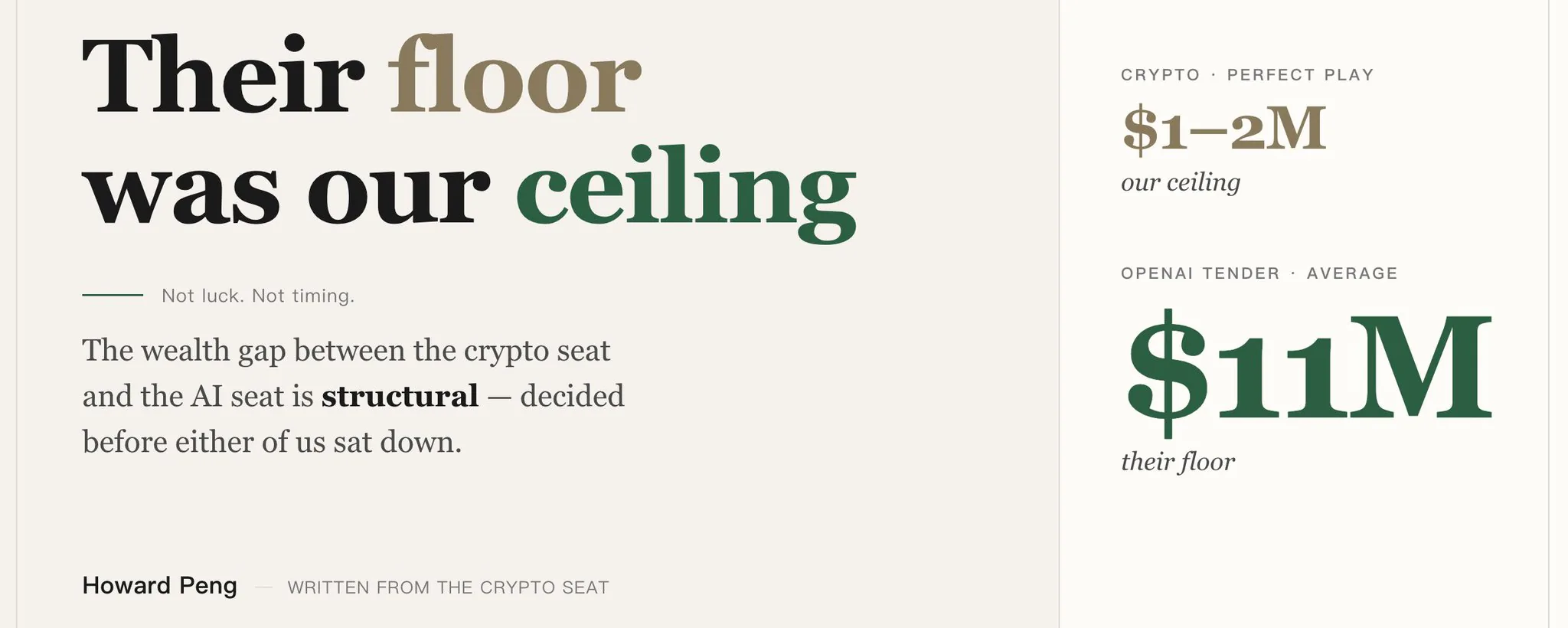
I joined Binance in the summer of 2018. Base pay was somewhere between 12,000 and 15,000 RMB a month, call it fifteen hundred US dollars on a good one. This is the point in the story where, if you have read enough of these, you brace for the turn: and then the token went up, and everything changed.
It did not. I am being exact about this on purpose, because the whole thing collapses if I round it the way these stories usually get rounded.
Do the math with me. It has never once come out kinder. Say I had put half of every paycheck into BNB, every month, starting in 2018. Say I had the stomach to hold through every drawdown without selling, including the ones that took most of it back, all the way to the 2021 top. The ceiling on that, the best case for someone in my seat playing the game perfectly, was roughly one to two million dollars. That is not nothing. In most of the world it is the whole arc of a life. I want that number sitting in your head, because it was a ceiling, and it cost near-perfect play to reach.
Now hold it next to a floor. In October 2025 OpenAI ran an internal tender. Six and a half billion dollars, more than 600 current and former employees, average payout around eleven million each. More than 75 of them sold the maximum the company allowed, and the maximum was thirty million dollars a person, a cap OpenAI had tripled from ten million after outside investors asked for more room to buy in. No drawdowns to stomach. No top to time. You did the work, the equity accrued, and a company-run market showed up to turn it into cash. Their floor was a number I could only reach in a spreadsheet with hindsight and a cast-iron gut.
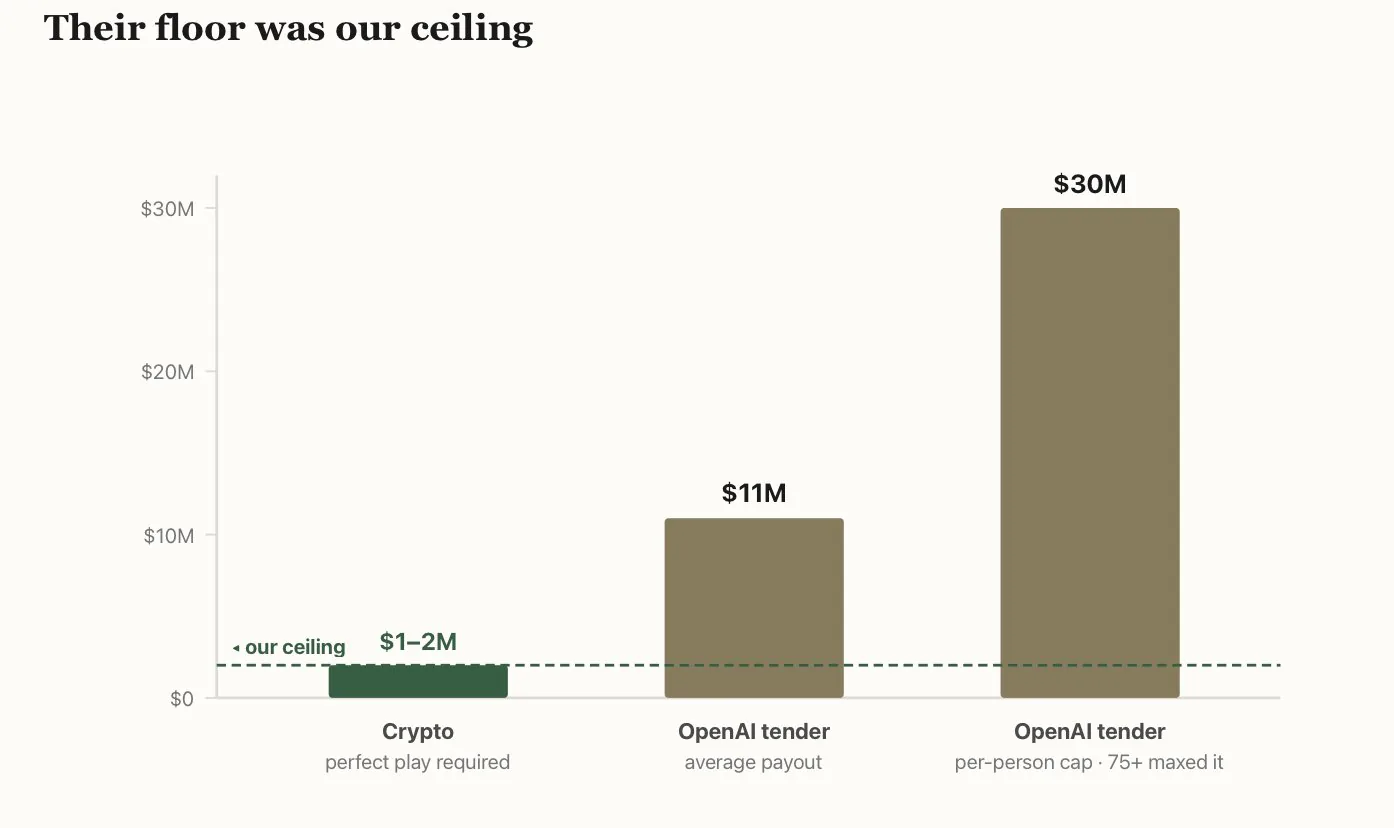
*Crypto, played perfectly: a $1–2M ceiling you had to time flawlessly — hold through every drawdown to the 2021 top. OpenAI's October 2025 tender: $11M on average, no market call required. Even their average towers over our best case.*
**Their floor was our ceiling.**
This month a thread went viral describing the world that floor created. Deedy (@deedydas) wrote it, and it is worth reading. The vibes in San Francisco, he said, feel frenetic. A group of maybe ten thousand people have hit retirement-grade wealth in a few years, and everyone outside that group feels the door closing. He sorted the rest into the recognizable groups. The engineers who think their life's skill just stopped mattering. The middle managers watching their layer get hollowed out with no network and no AI on the resume. And the people who already made it, one of whom told him he would not sell his company because if he sold it he would only have the money. I read it the way you read something that is accurate about you. He is not wrong, and I am not going to pretend the anxiety he is describing skips me. It does not. But I have been sitting one industry over, and from the crypto seat the same picture reads worse, and not for the reason the thread thinks.
The thread treats the gap as a thing that happened to people. Timing, luck, being in the room. I spent the last couple of years running technical due diligence on deals, reading other people's cap tables for a living, and that work ruins you for the luck story. You stop seeing fortune and start seeing structure. The gap between my ceiling and their floor is not one variable. It is four, stacked, and each one multiplies the next.
Start with who owns the thing. CZ held something like ninety percent of Binance. Sam Altman, famously, held no equity in @OpenAI for years. That sounds like a point about greed. It is not. It is a point about distribution. When the founder keeps almost everything, the upside that reaches the 2018 hire in Asia is a rounding error by construction. When the founder holds little, the equity pool that everyone else divides is enormous, and an early-but-not-founding employee can end up holding a stake that prints. Same success, opposite distribution, decided years before anyone knew who won.
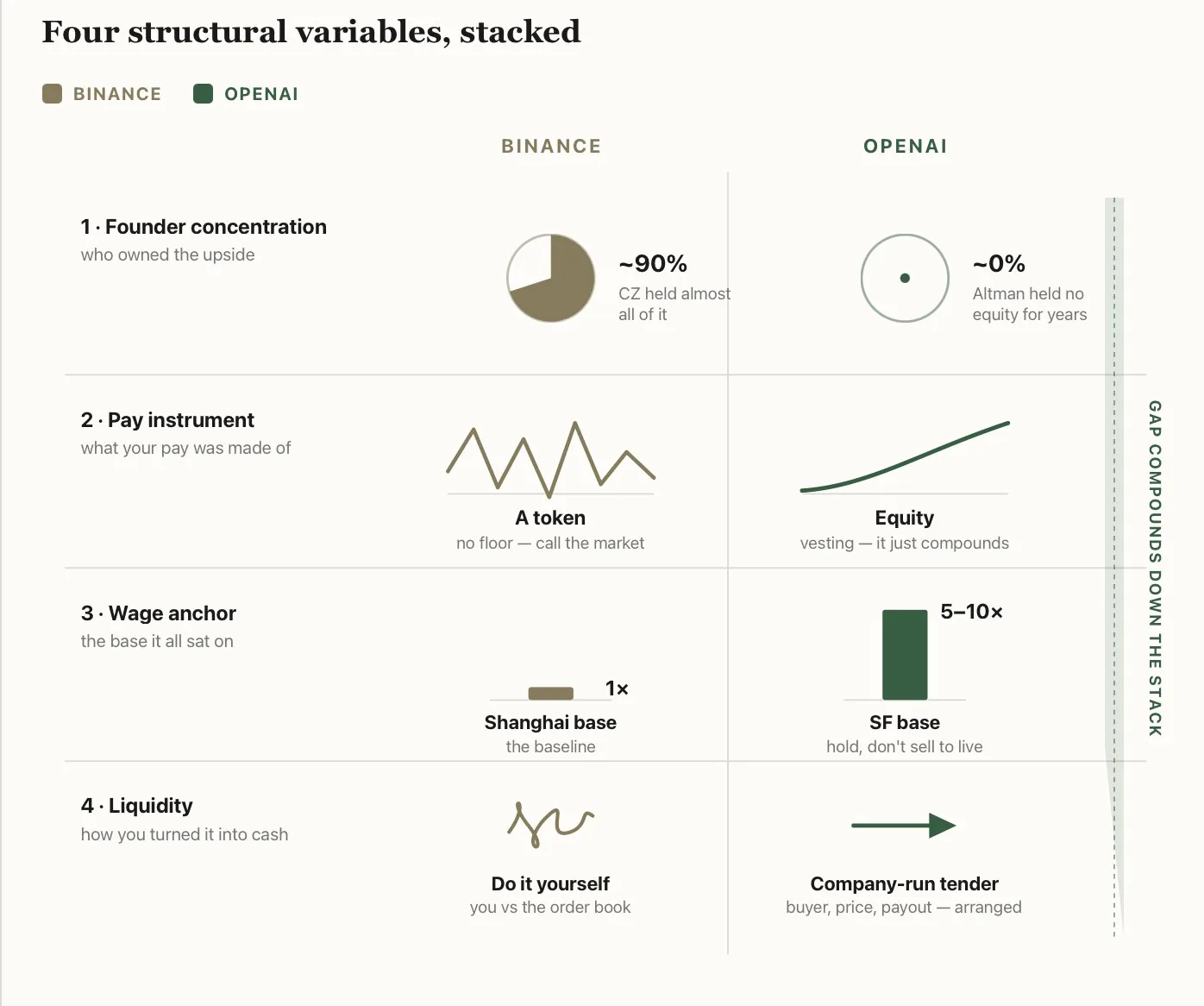
*Not one variable — four, stacked, and each one multiplied the next. The gap between my ceiling and their floor was decided above my pay grade and before my start date.*
Then the instrument they paid you in. We were paid, effectively, in a token. A token has no vesting cliff protecting you from yourself and no floor under you on the way down. To win with it you had to make a market call, in size, and then a second call to actually get out, and most people got neither right. They were paid in equity with structured vesting. Equity does not ask you to be a trader. It just sits there and compounds while you do your job, and the worst case is usually still a number.
Then the wage it all sat on top of. My base was a Shanghai base. Theirs was a San Francisco base, five to ten times higher before a single share is counted. That gap is not just lifestyle. The high base is what lets you hold the equity instead of selling it to live, which means the structural advantage compounds the behavioral one. The people best positioned to wait were the ones who least needed to.
And then how you got liquid. We had do-it-yourself liquidity. You against the order book, trying to time an exit in an asset that could fall eighty percent while you hesitated. They had a company-run tender. OpenAI did not make its people find a buyer. It organized the buyer, set the price, set the cap, and wired the money. The single hardest part of the whole thing, turning paper into cash without destroying the price, was handled for them as a benefit.
Founder concentration, the pay instrument, the wage anchor, the liquidity mechanism. Multiply them and you land somewhere most people find counterintuitive, and it is the part I cannot stop turning over. Crypto, the industry whose entire pitch was decentralization, concentrated wealth harder than almost anything before it. It minted a short list of billionaires, CZ, Brian Armstrong, SBF at the paper peak, and very few millionaires under them. AI, the centralized industry run by a handful of labs, is the one that actually distributed. Six hundred people, eleven million on average, in one afternoon. The thing that did the distributing was not an ideology. It was a structured internal market, the most boring possible piece of financial plumbing, and it moved more wealth to more ordinary employees than a decade of decentralization rhetoric ever did. We were told the trustless system would democratize the upside. The system that actually democratized it had a cap table, a tender administrator, and a thirty-million-dollar limit it had to raise because demand was too high.
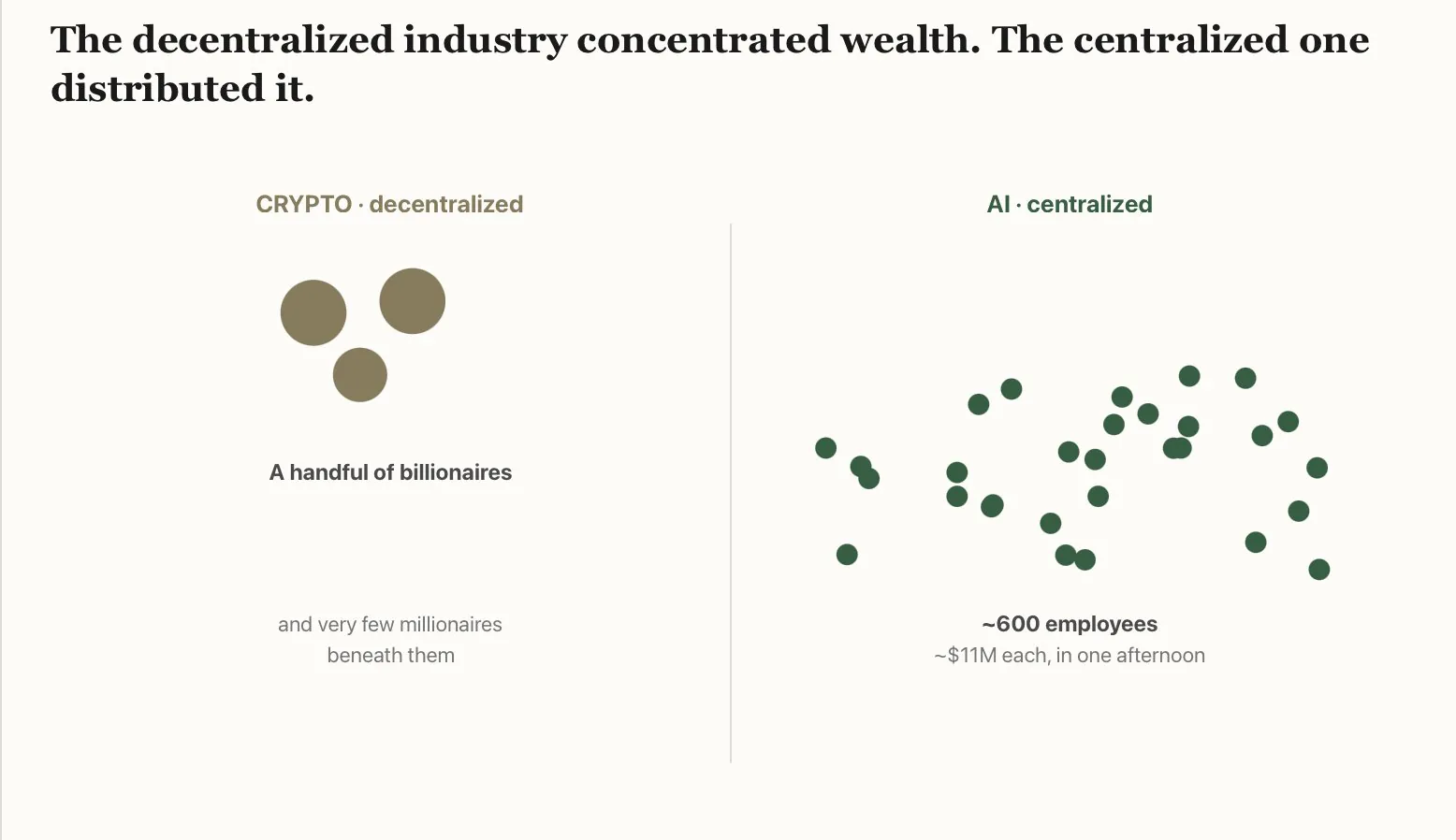
*Crypto's entire pitch was decentralization, and it concentrated wealth harder than almost anything before it. AI, run by a handful of labs, is the industry that actually distributed it — through the most boring possible piece of financial plumbing: a structured internal market.*
I do not have the clean ending here. The honest version of this essay does not resolve, because I have not resolved it. Greg Brockman (@gdb) testified in court this month that his OpenAI stake is worth close to thirty billion dollars, and when the lawyer asked if he just happened to be thirty billion dollars richer, he said compensation was secondary to the mission. I believe him, and it does not help. The math still runs in my head some nights, the half-paycheck-into-BNB math, the perfect-play ceiling that was their floor.
What changed is not the anxiety. It is what the anxiety means. For years it felt like a verdict, like the number was a score and mine said I had chosen wrong, worked at the wrong desk, been the wrong kind of smart. Reading enough cap tables beats that out of you. You see that the gap was set by four structural variables that were decided above your pay grade and before your start date, and that no amount of being early or working harder at my seat in 2018 was going to bend them. That does not make you richer. It does not even make you calmer, exactly. It just stops the number from being about you.
The frenetic energy Deedy is describing is ten thousand people reading a structural outcome as a personal one. I have read the structure. I am still anxious. I am just no longer confused about whose verdict it is, because it was never a verdict. It was a cap table, drawn before any of us sat down.
## References
- OpenAI 2025-10 employee tender — $6.6B · 600+ people · ~$11M average · 75+ hit the $30M cap — [finance.yahoo.com](https://finance.yahoo.com/markets/stocks/articles/600-openai-employees-scored-6-162500548.html)
- Greg Brockman's ~$30B stake + "mission first" testimony (Musk v. OpenAI, 2026-05-04) — [nbcnews.com](https://www.nbcnews.com/tech/tech-news/musk-lawyer-hammers-openai-co-founder-30-billion-stake-rcna343518)
- CZ held ~90% of Binance equity — [dlnews.com](https://www.dlnews.com/articles/people-culture/binance-founder-and-ceo-changpeng-zhao-released-from-prison)
- Sam Altman held no OpenAI equity for years — [cnbc.com](https://www.cnbc.com/2024/12/10/billionaire-sam-altman-doesnt-own-openai-equity-childhood-dream-job.html)
- Deedy's original thread — [x.com/deedydas](https://x.com/deedydas/status/2055491938464489888)
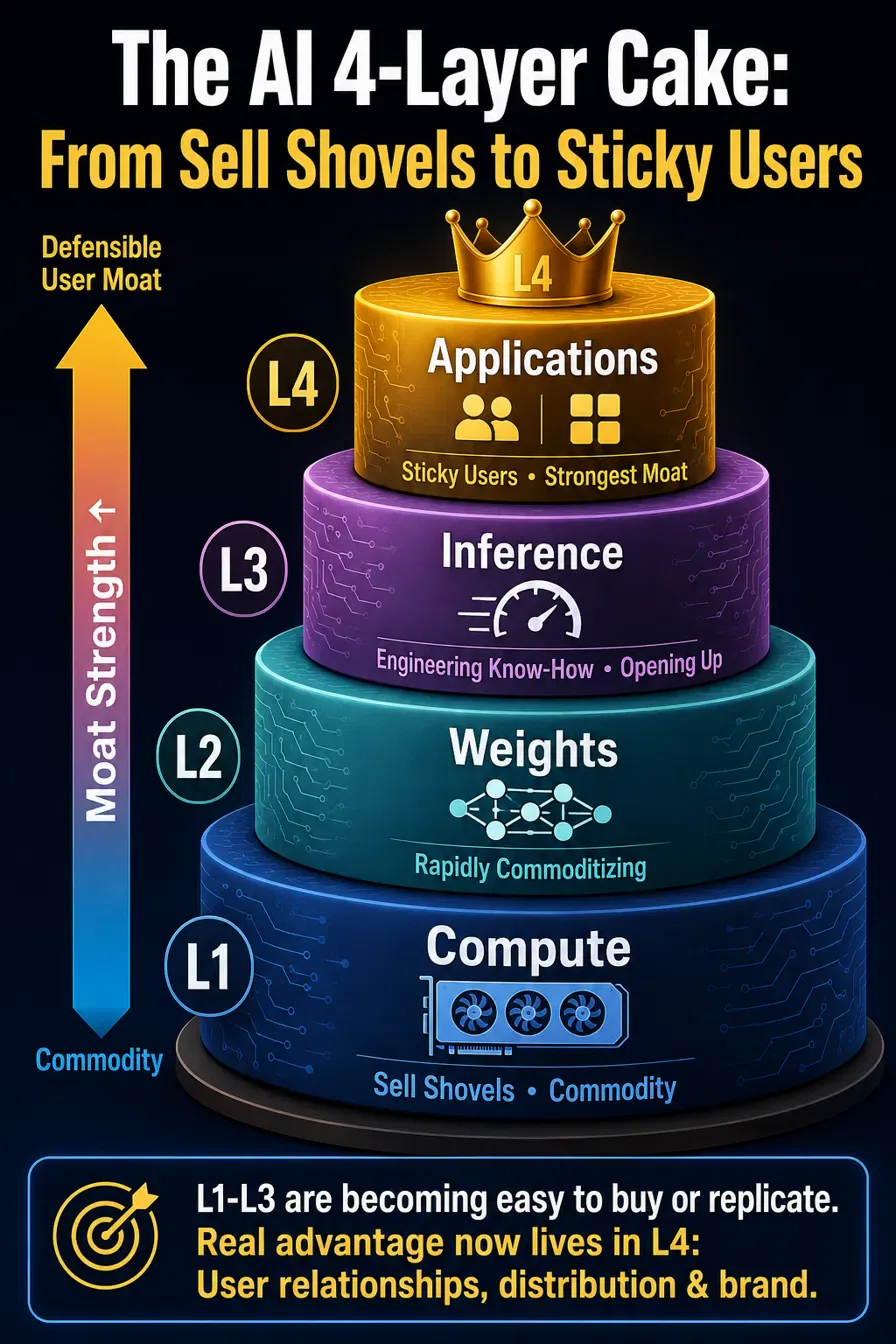 *Fig 1 — The four-layer cake: scarcity climbs from commodity at the base to a user moat on top.*
Bottom to top. Lower layers sell shovels. Upper layers own users.
- **L1 Compute** — the hardware that runs models. GPUs. Data centers. Rent an H100 with a card. Already a commodity.
- **L2 Weights** — the trained model itself. DeepSeek keeps open-sourcing them. Commoditizing fast.
- **L3 Inference** — run the same model faster and cheaper. Quantization. KV compression. Speculative decoding. This was each lab's private serving know-how. Not anymore.
- **L4 Applications** — the products that reach users. Brand. Distribution. Narrative.
One rule: **scarcity moves up.** Once anyone can do the bottom three layers, the only money left sits at the top.
Hold onto that conclusion — **the bottom three layers are out of reach for those of us without capital, but L4 needs none.** I'll come back at the end to how you actually fight there.
## What makes DeepSpec special: it open-sources the back-kitchen, not the dish
Why L3 is a moat. You train a model **once**. After that, millions of people query it every day. **Every query burns compute.**
The pain is built in. LLMs emit one token at a time. Each token forces a full forward pass over a trillion-parameter beast. Token by token. Sequential. Slow.
Speculative decoding breaks the pattern. A cheap **draft model** guesses a run of tokens. The big model verifies the whole run with **one** forward pass, in parallel. Hits are free. "Fast and cheap" just means one expensive pass buys you several tokens.
How you train that draft model — and how well it guesses — used to be each serving team's secret. DeepSpec open-sourced the whole thing under MIT. It runs on a single 8-GPU machine. The metric it measures is **acceptance**: for every run the draft guesses, how many tokens the big model keeps on average. Higher acceptance, more tokens per expensive pass, higher tok/s. How they turned this back-kitchen craft into a commodity — I'll break it down in a moment.
Put simply: **before, you either spent six months staffing your own serving team or paid a back-kitchen like Together or Fireworks. Now the recipe is on GitHub. Free.**
## Getting the terms straight: serving, inference, post-training
Three terms people blur together.
**Q: Is serving the same as inference? And does this count as post-training?**
They overlap in practice, but the clean relationship is **serving ⊇ inference**.
**Inference** is the raw act: run the model once and compute the output. Pure compute. Tokens in, tokens out.
**Serving** is the full production system. Batching. Queuing thousands of requests. Auto-scaling. KV cache. API layer. Load balancing. In one line, serving is the whole customer-service system for "people who spend tokens." Inference is just the core calculation inside it.
**Does it count as post-training? No — and this is the clarification that matters most, the one I trip over myself.**
Post-training happens after pre-training: SFT, RLHF, RLVR, distillation. **These all change weights.** So it belongs to **L2 (the weights layer)**, not L3.
L3 (inference / serving) is the **deployment and execution** stage. The base model's weights stay frozen; you just make an already-trained model faster and cheaper — quantization, KV compression, speculative decoding, batching. DeepSpec's draft model never touches the big model: the big model stays frozen, you raise a small separate model to **guess what it will say**. And speculative decoding is **lossless** — the verification pass guarantees the same output distribution the big model would produce on its own: bit-identical under greedy decoding, same distribution (not necessarily the same sample) under temperature sampling. No quality haircut, just sooner.
The dividing line in one sentence: **anything that changes the *base model's* weights (post-training included) is L2; anything that leaves them alone and bolts on auxiliary machinery to run it faster (draft models, quantization, KV compression) is L3.** Yes, the draft model gets trained too — but it never moves a gram of the base model's weights. DeepSpec lives cleanly in L3.
## And this time it sweeps two layers at once
Don't miss the other move they made at the same time. DeepSeek dropped **V4-Pro-DSpark** on Hugging Face too. 893GB. fp8. MoE flagship. And they **welded the draft head straight on top.**
So this drop isn't one layer open-sourced. It's **two at once**: L2 (the V4 weights) + L3 (the DSpark draft model plus the full training-and-eval recipe). Same week. Of the bottom three layers of the cake, only L1 still takes real money to buy cards — and that layer you could always rent.
## How DeepSpec commoditizes the whole layer
Step back. When does a capability turn into a commodity? It needs four things at once. **The recipe is public. It's reproducible. It's measurable and comparable. And it ships free, bundled with the layer below.** DeepSpec and DSpark hit all four. That's the mechanism.
**1. Turn black magic into a documented pipeline.** How you train a draft model. How you collect the data. The loss setup. Aligning to the target distribution. All of it used to be back-kitchen craft. DeepSpec open-sourced the full `data prep → train → eval` chain under MIT. Once a craft becomes a document anyone can copy, it stops being a craft.
**2. Turn it into a measurable, comparable benchmark.** This one hurts. They put **DSpark, DFlash, and Eagle3** on the **same eval bench**, scored by acceptance across the same tasks (GSM8K, HumanEval, LiveCodeBench…). The moment something has a leaderboard, it drops from "secret" to "engineering problem": teams converge on the same best practice, and no one charges a premium for "our decoding is faster." **Leaderboard = commoditize.** (One honest note: DSpark ships with its own paper and claims to be a new method, but the public README gives no head-to-head numbers against Eagle3 and doesn't spell out what's new. So how much DSpark actually wins by is unproven. What's certain is the track is now a public, comparable race.)
**3. Ship the finished piece inside the weights.** The HF card for DeepSeek-V4-Pro-DSpark states it plainly: "**not a new model — the same checkpoint with a speculative-decoding module attached.**" The accelerator is **pre-installed in the weights**; even "train your own draft" is off your plate. Giving away the layer below and tossing in the layer above for free is the standard move for pushing commoditization up a notch.
**4. Stack V4's cheap attention on top, cutting cost from both ends.** DSpark cuts decode steps — one forward pass, multiple tokens. The V4 model itself, with its CSA + HCA hybrid attention, cuts compute and memory per step — official numbers: at million-token context, single-token inference takes just **27% of the FLOPs and 10% of the KV cache** of V3.2. Squeeze both axes and L3's cost curve caves in.
The result: anyone can hit the same tok/s and $/token with the same recipe and the same draft. **L3's "algorithm premium" gets flattened — that's commoditization.**
But one boundary stays real: **what gets commoditized is the *algorithm* layer, not the *operations* layer.** "The recipe is public" doesn't equal "you can run it fast and cheap at scale." The moat that remains: GPU-fleet utilization, large-scale batching, in-house CUDA kernels, latency SLAs, real power costs and hardware depreciation. DeepSpec pulled back the curtain on the **algorithmic** know-how of speculative decoding; the **operational** know-how of serving-at-scale still earns its keep. So L3 is **half-drained, not bone-dry** — marking L3 as "hit this drop" in the diagram below is fair, but it won't collapse all the way like L2.
## So what are they after?
DeepSeek open-sourced a serving recipe. What's the play? Work through the pieces and the answer is simple: **they're tearing down the advantage US AI built by piling up capital.**
US rounds are already impossible to match. Record single rounds in the tens of billions. At the top, OpenAI and Anthropic run big revenue, bigger burn, and raise more still. The whole story rests on one line: **"AI costs a fortune to play."** Valuations, fundraising, talent — all of it grows from that sentence.
DeepSeek attacks that sentence with everything it ships:
- Open-source the weights (L2) and "you need billions to train a model" starts to crack.
- Open-source the serving recipe (L3) and "you need a top crew just to run it cheap" cracks too.
- Hit both layers at once and the cracks spread twice as fast.
It can't open-source OpenAI's balance sheet. No one can. But it can do something sharper: **make that balance sheet matter less.** Once the layers below are free and copyable, the story that "you need to burn serious money to compete" collapses — and that story is what holds up the hundreds-of-billions valuations.
This isn't charity. It's **tactics.** You can't out-raise the US on size, so you blow up the premise that you need that much capital at all.
*Fig 1 — The four-layer cake: scarcity climbs from commodity at the base to a user moat on top.*
Bottom to top. Lower layers sell shovels. Upper layers own users.
- **L1 Compute** — the hardware that runs models. GPUs. Data centers. Rent an H100 with a card. Already a commodity.
- **L2 Weights** — the trained model itself. DeepSeek keeps open-sourcing them. Commoditizing fast.
- **L3 Inference** — run the same model faster and cheaper. Quantization. KV compression. Speculative decoding. This was each lab's private serving know-how. Not anymore.
- **L4 Applications** — the products that reach users. Brand. Distribution. Narrative.
One rule: **scarcity moves up.** Once anyone can do the bottom three layers, the only money left sits at the top.
Hold onto that conclusion — **the bottom three layers are out of reach for those of us without capital, but L4 needs none.** I'll come back at the end to how you actually fight there.
## What makes DeepSpec special: it open-sources the back-kitchen, not the dish
Why L3 is a moat. You train a model **once**. After that, millions of people query it every day. **Every query burns compute.**
The pain is built in. LLMs emit one token at a time. Each token forces a full forward pass over a trillion-parameter beast. Token by token. Sequential. Slow.
Speculative decoding breaks the pattern. A cheap **draft model** guesses a run of tokens. The big model verifies the whole run with **one** forward pass, in parallel. Hits are free. "Fast and cheap" just means one expensive pass buys you several tokens.
How you train that draft model — and how well it guesses — used to be each serving team's secret. DeepSpec open-sourced the whole thing under MIT. It runs on a single 8-GPU machine. The metric it measures is **acceptance**: for every run the draft guesses, how many tokens the big model keeps on average. Higher acceptance, more tokens per expensive pass, higher tok/s. How they turned this back-kitchen craft into a commodity — I'll break it down in a moment.
Put simply: **before, you either spent six months staffing your own serving team or paid a back-kitchen like Together or Fireworks. Now the recipe is on GitHub. Free.**
## Getting the terms straight: serving, inference, post-training
Three terms people blur together.
**Q: Is serving the same as inference? And does this count as post-training?**
They overlap in practice, but the clean relationship is **serving ⊇ inference**.
**Inference** is the raw act: run the model once and compute the output. Pure compute. Tokens in, tokens out.
**Serving** is the full production system. Batching. Queuing thousands of requests. Auto-scaling. KV cache. API layer. Load balancing. In one line, serving is the whole customer-service system for "people who spend tokens." Inference is just the core calculation inside it.
**Does it count as post-training? No — and this is the clarification that matters most, the one I trip over myself.**
Post-training happens after pre-training: SFT, RLHF, RLVR, distillation. **These all change weights.** So it belongs to **L2 (the weights layer)**, not L3.
L3 (inference / serving) is the **deployment and execution** stage. The base model's weights stay frozen; you just make an already-trained model faster and cheaper — quantization, KV compression, speculative decoding, batching. DeepSpec's draft model never touches the big model: the big model stays frozen, you raise a small separate model to **guess what it will say**. And speculative decoding is **lossless** — the verification pass guarantees the same output distribution the big model would produce on its own: bit-identical under greedy decoding, same distribution (not necessarily the same sample) under temperature sampling. No quality haircut, just sooner.
The dividing line in one sentence: **anything that changes the *base model's* weights (post-training included) is L2; anything that leaves them alone and bolts on auxiliary machinery to run it faster (draft models, quantization, KV compression) is L3.** Yes, the draft model gets trained too — but it never moves a gram of the base model's weights. DeepSpec lives cleanly in L3.
## And this time it sweeps two layers at once
Don't miss the other move they made at the same time. DeepSeek dropped **V4-Pro-DSpark** on Hugging Face too. 893GB. fp8. MoE flagship. And they **welded the draft head straight on top.**
So this drop isn't one layer open-sourced. It's **two at once**: L2 (the V4 weights) + L3 (the DSpark draft model plus the full training-and-eval recipe). Same week. Of the bottom three layers of the cake, only L1 still takes real money to buy cards — and that layer you could always rent.
## How DeepSpec commoditizes the whole layer
Step back. When does a capability turn into a commodity? It needs four things at once. **The recipe is public. It's reproducible. It's measurable and comparable. And it ships free, bundled with the layer below.** DeepSpec and DSpark hit all four. That's the mechanism.
**1. Turn black magic into a documented pipeline.** How you train a draft model. How you collect the data. The loss setup. Aligning to the target distribution. All of it used to be back-kitchen craft. DeepSpec open-sourced the full `data prep → train → eval` chain under MIT. Once a craft becomes a document anyone can copy, it stops being a craft.
**2. Turn it into a measurable, comparable benchmark.** This one hurts. They put **DSpark, DFlash, and Eagle3** on the **same eval bench**, scored by acceptance across the same tasks (GSM8K, HumanEval, LiveCodeBench…). The moment something has a leaderboard, it drops from "secret" to "engineering problem": teams converge on the same best practice, and no one charges a premium for "our decoding is faster." **Leaderboard = commoditize.** (One honest note: DSpark ships with its own paper and claims to be a new method, but the public README gives no head-to-head numbers against Eagle3 and doesn't spell out what's new. So how much DSpark actually wins by is unproven. What's certain is the track is now a public, comparable race.)
**3. Ship the finished piece inside the weights.** The HF card for DeepSeek-V4-Pro-DSpark states it plainly: "**not a new model — the same checkpoint with a speculative-decoding module attached.**" The accelerator is **pre-installed in the weights**; even "train your own draft" is off your plate. Giving away the layer below and tossing in the layer above for free is the standard move for pushing commoditization up a notch.
**4. Stack V4's cheap attention on top, cutting cost from both ends.** DSpark cuts decode steps — one forward pass, multiple tokens. The V4 model itself, with its CSA + HCA hybrid attention, cuts compute and memory per step — official numbers: at million-token context, single-token inference takes just **27% of the FLOPs and 10% of the KV cache** of V3.2. Squeeze both axes and L3's cost curve caves in.
The result: anyone can hit the same tok/s and $/token with the same recipe and the same draft. **L3's "algorithm premium" gets flattened — that's commoditization.**
But one boundary stays real: **what gets commoditized is the *algorithm* layer, not the *operations* layer.** "The recipe is public" doesn't equal "you can run it fast and cheap at scale." The moat that remains: GPU-fleet utilization, large-scale batching, in-house CUDA kernels, latency SLAs, real power costs and hardware depreciation. DeepSpec pulled back the curtain on the **algorithmic** know-how of speculative decoding; the **operational** know-how of serving-at-scale still earns its keep. So L3 is **half-drained, not bone-dry** — marking L3 as "hit this drop" in the diagram below is fair, but it won't collapse all the way like L2.
## So what are they after?
DeepSeek open-sourced a serving recipe. What's the play? Work through the pieces and the answer is simple: **they're tearing down the advantage US AI built by piling up capital.**
US rounds are already impossible to match. Record single rounds in the tens of billions. At the top, OpenAI and Anthropic run big revenue, bigger burn, and raise more still. The whole story rests on one line: **"AI costs a fortune to play."** Valuations, fundraising, talent — all of it grows from that sentence.
DeepSeek attacks that sentence with everything it ships:
- Open-source the weights (L2) and "you need billions to train a model" starts to crack.
- Open-source the serving recipe (L3) and "you need a top crew just to run it cheap" cracks too.
- Hit both layers at once and the cracks spread twice as fast.
It can't open-source OpenAI's balance sheet. No one can. But it can do something sharper: **make that balance sheet matter less.** Once the layers below are free and copyable, the story that "you need to burn serious money to compete" collapses — and that story is what holds up the hundreds-of-billions valuations.
This isn't charity. It's **tactics.** You can't out-raise the US on size, so you blow up the premise that you need that much capital at all.