在 xAI 工作的這些人,到底在意什麼?
兩週前,我看到一條推文。
它大概在說:現在全世界的人都想擠進那幾家 frontier AI lab——彷彿你進不去,就會被這個時代淘汰。
它戳中我了,因為它沒說錯。2026 年,對這些 frontier AI lab 的員工來說,就像 2017 年的 Binance——風口之上,人人搶著認識他們、擠進那扇門。
而我知道那是什麼感覺,因為上一個風口我在場——2018 年夏天,我加入了 Binance。只是這次不一樣的是規模:我那時拼到極限的天花板,差不多就是這一代的地板。(我把這件事寫成了另一篇。)
所以這件事給我一種五味雜陳的心態。而正是這種心態,讓我想去挖一件具體的事:這些站在風口上的 AI lab 的人,他們的社交畫像到底長什麼樣?這群已經在裡面的人,到底在意什麼? 他們每天在討論什麼、他們是什麼樣的人、他們的影響力到底從哪來——我想知道。而且我想知道得更多。
所以我做了一件有點偏執的事:從 xAI 公開的 affiliates 名單(x.com/xai/affiliates)出發——668 個公開帳號——把每個人公開可見的數據看了一遍:追蹤數、被追蹤數、bio、近 30 天的發文型態。全都是任何人點進去就看得到的東西;我看的不是 bio 寫什麼,是他們實際怎麼行為。
結果跟我預期的完全相反。
四種人,而且分佈很極端
把「你 follow 多少人」和「多少人 follow 你」這兩個數字畫成一張圖,四種很清楚的模式就跑出來了:
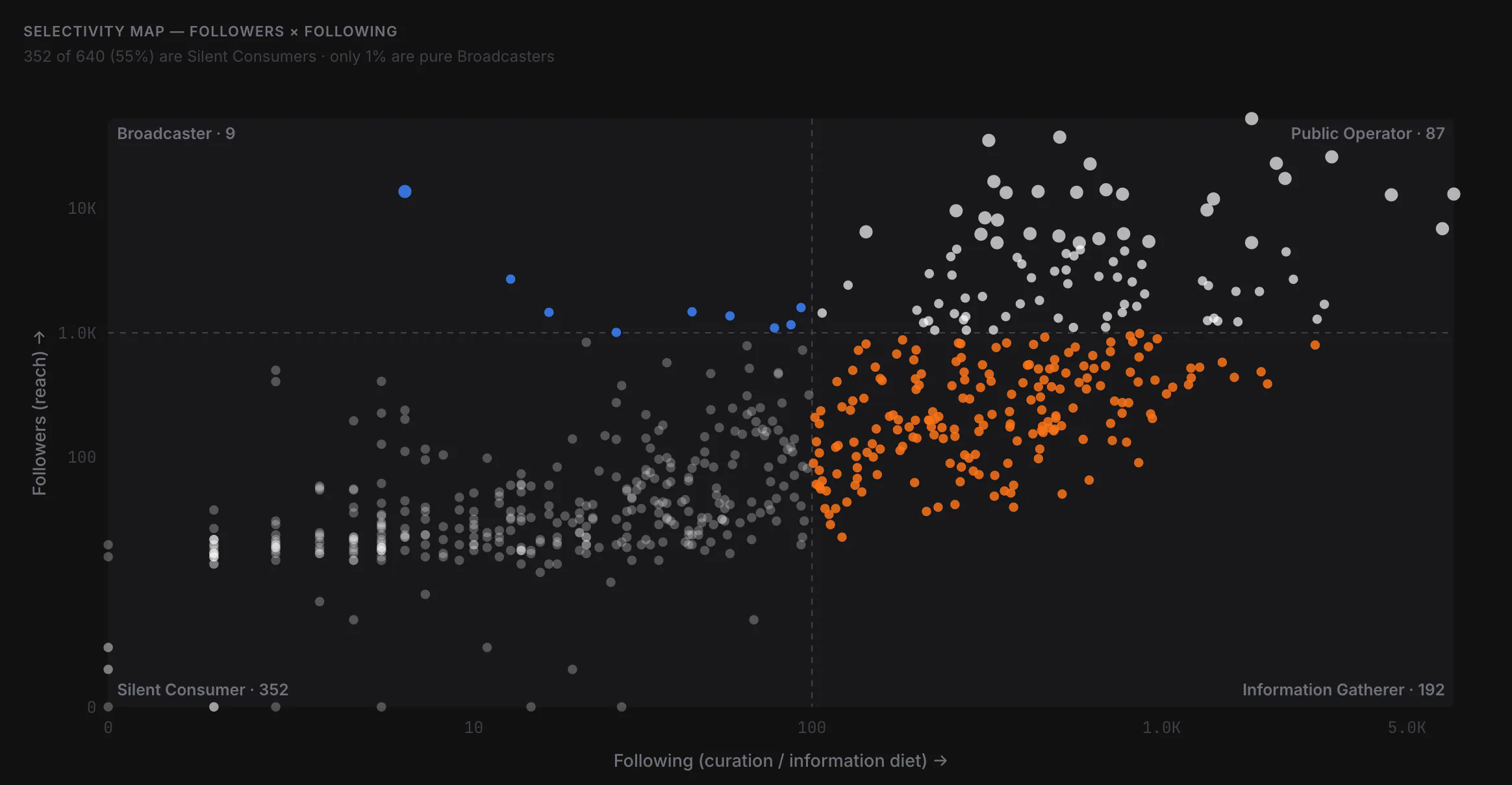 Fig 1 — X 軸 = 資訊攝取(你 follow 多少),Y 軸 = 觸及(多少人 follow 你)。
- Silent Consumer 沉默消費者 — 55%(352 人):幾乎不 follow 別人,也幾乎沒人 follow 他們。純潛水。
- Information Gatherer 資訊獵人 — 30%(192 人):follow 很多、自己沒什麼粉。在大量吸收資訊。
- Public Operator 公共操盤手 — 14%(87 人):又 follow、又有粉。真的在「經營」。
- Broadcaster 純廣播者 — 只有 1%(9 人):高觸及、低輸入。少數真正的廣播者。
超過一半的人幾乎不 follow 任何人、也幾乎沒人 follow——而真正高觸及、低輸入的廣播者只有 1%。在一群最前沿 AI 公司的人裡,將近六成在 X 上是隱形的。
第一眼:大部分人根本不經營自己的 X
這是稍微掃一下就看得出來的事,數據馬上佐證。在 640 個能算的帳號裡,44% 的人 bio 整片空白,八成是極簡 profile(不到 50 個字);53% 的人追蹤者不到 100,而追蹤者破十萬的——一個都沒有。而且他們的資訊攝取一樣窄:中位數只 follow 67 個帳號,56% 的人 follow 不到 100 個。
而且他們很多根本不是 X 老玩家。大約三分之一的帳號是 2025–2026 年才創的——差不多是他們進來的時候才開的,背後沒有十年的發文史。這不是一群在時間軸上「表演」長大的人。
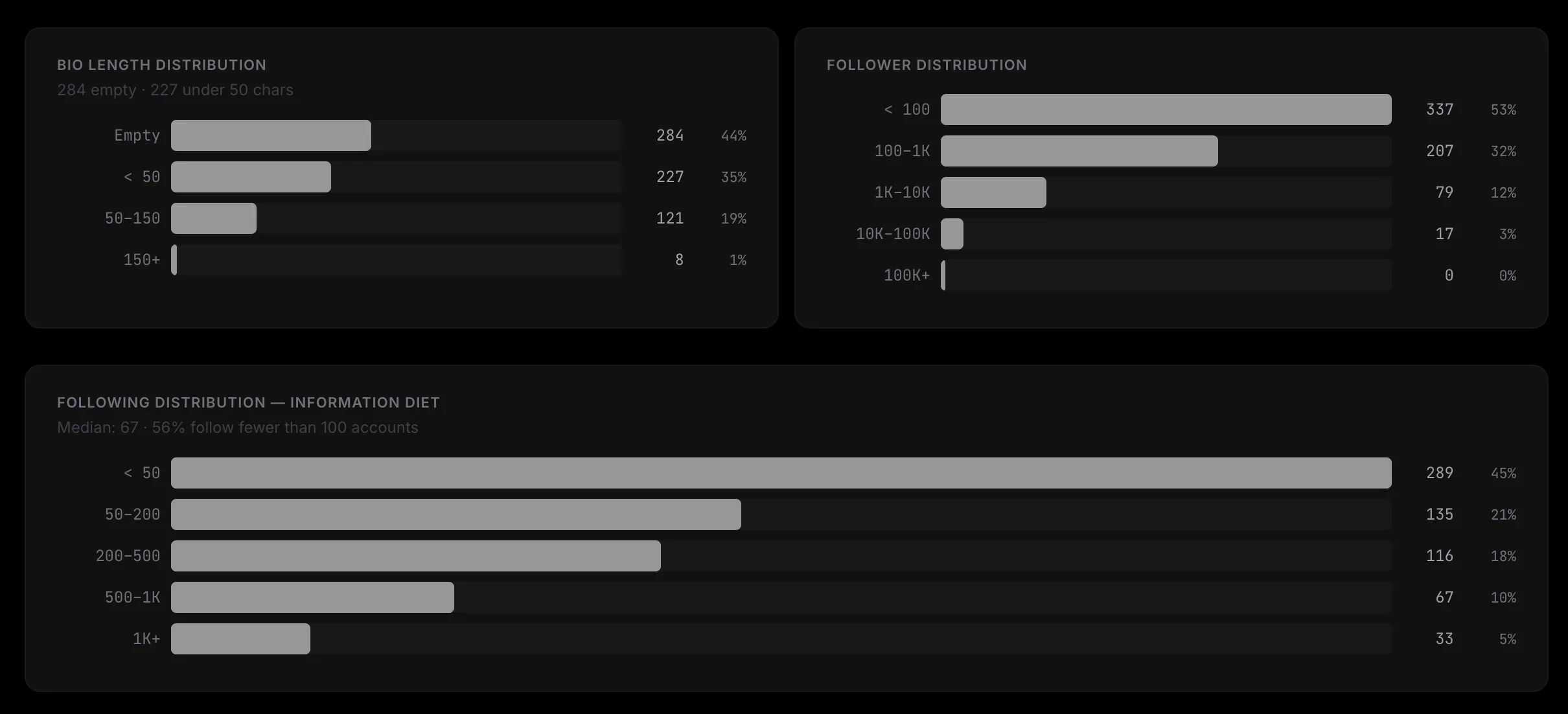 Fig 2 — bio 長度、追蹤者數、追蹤中數(資訊攝取)。
不過這個「八成極簡」要小心解讀——它很容易被讀成「這些人很懶、不會經營」。我反而覺得更接近真相的是另一面:他們根本不需要包裝自己。
對一個 xAI 的員工來說,handle 掛上、寫上 xAI,就已經是最好的名片了。bio 要不要寫滿、social 經營得好不好,對他們而言根本不是個問題。空白的 bio 不是疏忽,而是一種「不必證明什麼」的底氣。
點進去之後,我有點嫉妒
我是帶著焦慮進來的;但點開他們一個一個的 profile,我發現他們不只不怎麼經營自己的 X 帳號,還好像過得很鬆、很開心。那一刻,焦慮變成了一點點嫉妒——而我嫉妒的,不是他們生活爽,是他們不必花任何一秒去證明自己。
而且他們聚在工作所在地
不到一半的人有填地點——另外 55% 是空白。有填的那些,壓倒性集中在灣區(Palo Alto、San Francisco、Mountain View),還有一小撮在 Memphis(xAI 的 Colossus 超級電腦就在那),以及倫敦一小群。這群人的地圖,基本上就是算力的地圖。
有寫經歷的人,才會把名校、大廠、PhD @ 出來
跟別人提的時候,很多人會把自己的學校(通常是那種頂尖學校)、或從 FAANG 這種大公司出來的經歷、或所謂的 PhD,@ 在自己的 bio 上。
只有在「有寫 bio」的那群人裡,才看得到這些標記——頂尖名校、大廠出身、PhD。而這正好反過來說明了前面那件事:會把資歷掛出來的,是還需要證明自己的那一小群;其他人,連證明都省了。
還有一件事:他們其實很少「廣播」
把這群人近 30 天的貼文全攤開——4,321 篇,日均 144 篇,看起來不少。但拆開貼文類型才有意思:只有 10% 是原創貼文。 其餘是回覆(48%)、轉推(30%)、引用(12%)。
換句話說,就算這群人在 X 上動起來,他們大多在回應別人、轉發別人,而不是自己廣播。
這跟上面那張圖對得起來:純廣播者只有 1%。
一群手握麥克風、又站在 AI 最前沿的人,絕大多數選擇了聽,而不是講。
那,影響力呢?
這是我最初的第二個問題,而 follow 圖開始給出答案了。
我把其中一部分人的完整 following 名單拉出來,依「有多少人 follow 這個帳號」把每個帳號排名——一張粗略的「這群人集體在注意誰」的地圖。我本來以為會是 AI Twitter:那些有名的研究者、lab 創辦人、我自己會讀的那些 thread。結果排在最前面的,不是這些。
排在最前面的是兩種:他們自己的同事,還有 Musk 的營運軌道。 這群人內部最多人 follow 的,是其他 xAI 的人——緊接在後的,是 SpaceX,不是 AI。Michael Nicolls、Gwynne Shotwell(SpaceX 總裁)的排名,高過幾乎所有外部的 AI 研究者。其他 frontier lab 幾乎排不上。
原始數字裡還有個轉折。單看個人,他們的攝取其實是向外的——只有大約 14% 的 follow 指向 xAI 內部。但把整群人加起來,注意力又疊回一小撮內部核心。一個一個看很分散;當成一群看,卻很集中。
所以我帶走的 model 是:
在 frontier lab,影響力不是 follower 數——而是一張「向內、繞著創辦人轉」的圖。 訊號在同事之間、在創辦人真實世界的軌道裡循環。它不會向外廣播到你以為必須擠進去的那個公開「AI 討論圈」。
這把常見的建議整個翻過來。如果你在外面想被看見——對著虛空發 hot take、養一批 AI Twitter 粉絲——你優化的是錯的地圖。你想觸及的那群人,根本不向外聽。他們埋著頭,follow 彼此、follow 那個使命。
這也是我還在拉的線:誰才是真正的樞紐、那個核心有多緊、是不是每家 lab 都長一樣。因為 2026 年的 frontier AI lab,就是 2017 年的 Binance——風口之上,真正值得知道的,是這扇門後面,到底誰說話算數。
我想知道更多。
(順帶一提:我把這套「丟一份名單進去、看它真實怎麼運作」的方法,做成了能套用到任何名單上的東西。但那是另一個故事了。)
References
- 觸發這一切的推文 — x.com/deedydas/status/2068238634600554699
- 為什麼這個位子讓我在意:〈Their floor was our ceiling〉— x.com/howard_/status/2057837810548420731
- xAI 官方 affiliates 名單 — x.com/xai/affiliates
- 我自己整理的四種模式 — x.com/howard_/status/2069638421623284086
What do the people building xAI actually care about?
Two weeks ago, I saw a tweet.
The gist: right now everyone in the world wants to squeeze into one of the frontier AI labs — as if, if you can't get in, the era leaves you behind.
It hit me, because it isn't wrong. In 2026, being at one of these frontier AI labs is what being at Binance was in 2017 — the top of the gale, everyone scrambling to know them, to get through that door.
And I know what that feels like, because I was there for the last gale — I joined Binance in the summer of 2018. What's different this time is the scale: the ceiling I could reach playing it perfectly is roughly this generation's floor. (I wrote that one up separately.)
So it left me with a complicated, bittersweet feeling. And that feeling is exactly what pushed me toward something concrete: these people standing at the top of the gale — what does their social portrait actually look like? The people already inside — what do they actually care about? What do they talk about every day, who are they, where does their influence even come from? I wanted to know. And I wanted to know more.
So I did something slightly obsessive: I started from xAI's public affiliates list (x.com/xai/affiliates) — 668 public accounts — and looked at the publicly visible data for each: followers, following, bios, and the 30-day post-type mix. Everything anyone can see by clicking through — not what the bio says, but how they actually behave.
The result was the opposite of what I expected.
Four types, and a brutally lopsided split
Plot two numbers — how many people you follow, and how many follow you — and four clear patterns fall out:
Fig 1 — X axis = information diet (how many you follow); Y axis = reach (how many follow you).
- Silent Consumer — 55% (352): follow almost no one, almost no one follows them. Pure lurkers.
- Information Gatherer — 30% (192): follow a lot, few followers of their own. Absorbing.
- Public Operator — 14% (87): both follow and are followed. Actually "operating."
- Broadcaster — only 1% (9): high reach, low input. The few true broadcasters.
More than half follow almost no one and are followed by almost no one — and genuinely high-reach, low-input broadcasters are just 1%. Inside one of the most cutting-edge AI companies, close to six in ten are invisible on X.
First glance: most of them don't really run their own X
You see it with barely a scan, and the data backs it up. Across the 640 measurable accounts, 44% have a completely empty bio, eight in ten are minimal profiles (under 50 characters); 53% have fewer than 100 followers, and the number with over 100k followers is — zero. And their information diet is just as narrow: the median person follows only 67 accounts, and 56% follow fewer than 100.
Many aren't even X natives. About a third of the accounts were created in just 2025–2026 — spun up around the time they arrived, not a decade of posting behind them. This isn't a group that grew up performing on the timeline.
Fig 2 — Bio length, follower count, and following count (information diet).
But that "eight in ten are minimal" is easy to misread — it sounds like "these people are lazy or bad at this." I think the truer reading is the opposite: they don't need to package themselves.
For someone at xAI, the handle plus the word "xAI" is already the best business card. Whether the bio is filled out, whether they "do social" well — none of it matters to them. An empty bio here isn't an oversight; it's the confidence of having nothing to prove.
And clicking through, I got a little envious
I came in carrying anxiety; but opening each profile one by one, I found that they not only don't bother with X — they also seem to be living pretty relaxed, happy lives. In that moment the anxiety turned into a bit of envy — and what I envied wasn't the easy life. It was that they don't spend a single second proving themselves.
And they cluster where the work is
Just under half list a location at all — the other 55% leave it blank. Of the ones who do, it's overwhelmingly the Bay Area (Palo Alto, San Francisco, Mountain View), with a small Memphis cluster — where xAI's Colossus supercomputer sits — and a London pocket. The map of this group is basically the map of where the compute is.
The ones with a story tag their school, their big-tech past, their PhD
When people do mention their background, many @ their school (usually a top one), or the FAANG-tier company they came from, or the PhD.
Those tags only show up among the people who bothered to write a bio at all — top schools, big-tech pedigree, PhDs. Which cuts the other way: the ones listing their credentials are the small group who still feel they have something to prove. Everyone else skips even that.
One more thing: they rarely "broadcast"
Lay out everything this group posted in the last 30 days — 4,321 posts, 144 a day on average. Sounds like a lot. But break it down by type and it gets interesting: only 10% are original posts. The rest are replies (48%), reposts (30%), and quotes (12%).
In other words, even when this group is active on X, they're mostly responding to others and resharing others — not broadcasting their own. Which lines up with the map: pure broadcasters are only 1%. A group handed megaphones, standing at the frontier of AI, mostly chose to listen rather than talk.
So — where does the influence come from?
That was my second question, and the follow graph starts to answer it.
I pulled the full following lists for a sample of the cohort and ranked every account by how many of them follow it — a rough map of who this group collectively pays attention to. I expected AI Twitter: the famous researchers, the lab founders, the threads I read myself. That is not what sits at the top.
At the top are two things: their own colleagues, and Musk's operational orbit. The most-followed accounts inside the group are other xAI people — and right behind them, SpaceX, not AI. Michael Nicolls and Gwynne Shotwell (SpaceX's president) rank above almost every outside AI researcher. Other frontier labs barely register.
The raw numbers have a twist, too. Individually, their diets point outward — only about 14% of who they follow is inside xAI. But collectively the attention piles back onto a small internal core. Diffuse one by one; concentrated as a group.
So here is the model I walked away with:
At a frontier lab, influence isn't a follower count — it's an inward-facing, founder-gravitational graph. The signal circulates among colleagues and the founder's real-world orbit. It doesn't broadcast out to the public "AI discourse" you think you have to break into.
Which flips the usual advice. If you're on the outside trying to get noticed — posting hot takes into the void, farming an AI-Twitter following — you're optimizing the wrong map. The people you want to reach aren't listening outward. They're heads-down, following each other and the mission.
That's the thread I'm still pulling: who the real hubs are, how tight the core is, whether every lab is shaped the same way. Because a frontier AI lab in 2026 is Binance in 2017 — and at the top of the gale, the thing worth knowing is who, behind that door, actually calls the shots.
I want to know more.
(By the way: I turned this whole "drop in a list, watch how it really behaves" approach into something that runs on any list. But that's another story.)
References
- The tweet that started all this — x.com/deedydas/status/2068238634600554699
- Why this seat matters to me: "Their floor was our ceiling" — x.com/howard_/status/2057837810548420731
- xAI's official affiliates list — x.com/xai/affiliates
- The four patterns, as I first mapped them — x.com/howard_/status/2069638421623284086

